
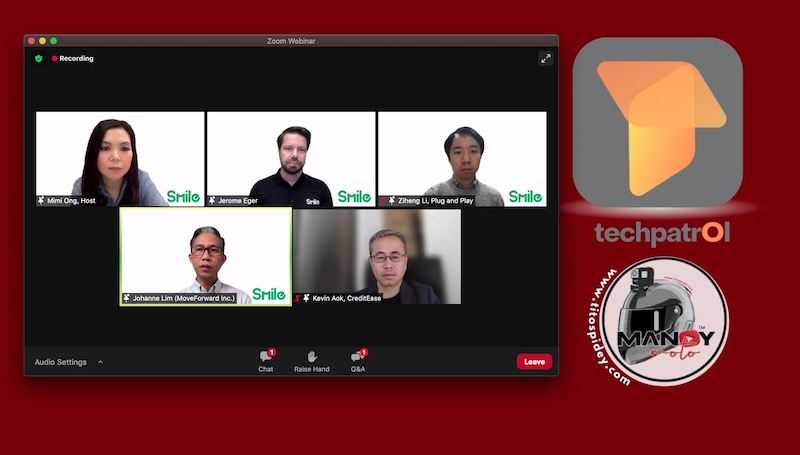
Applying for a loan or financing, whether for a vehicle, a company, a house, or anything else, is a time-consuming and labor-intensive procedure that necessitates the active participation of the applicant, their employer, and the relevant financial institution or vendor. Smile API is a digital platform that expedites the process by allowing application acceptance (or rejection) in a matter of seconds. As a result, it provides significant value to workers who require financial and/or related services; employers who can recoup operational time lost due to the cumbersome paper trail; and banks and financial institutions who can experience fast, secure transactions in the many moribund application procedures.

“Smile API empowers people to have their own data, and to use that data for their own good.”
During the recent company launch, Smile API CEO Jerome Eger explains the all-too-common situation that bogs down businesses: “We did a survey and found that on the average, for every 100 employees in any given company, there are three to five requests for certificates of employment per week. A person in HR handles this, and it takes company time that can be better used for other business matters. While they need to do this, this process has no value for the employers.”
Smile API CEO Jerome Eger
Eger adds, “What we offer becomes not just a win but a win-win-win solution for businesses, their employees, and mostly for third-party providers like banks, financial institutions, and other vendors whose services are made more accessible to potential customers.”
Individuals initially register through the Smile-API-using firms with which they engage or contact on a regular basis. When clients request loans, financing, delayed payment terms, employment, or financial services, they consent to submit their encrypted employment data, which is subsequently sent in seconds from their employer to the bank or vendor via the Smile API.
It’s vital to remember that this is a one-time deal. Smile API obtains the encrypted information from the employer and sends it to the institution or vendor. It does not keep the info after that. This procedure takes only a few seconds, saving the applicant, their company, and the connected banks time and effort, as well as the tension that comes with waiting for (or working toward) clearance that may or may not be granted.
Smile API’s platform was born out of a simple but crucial reality that impacts almost everyone, particularly the workforce, without their even realizing it. People will never have complete control over their personal and professional data. Their employment data, which is the most important to financial institutions, vendors, and even potential new employers, will always need to be obtained from third parties and verified by documentation such as certificates of employment, payslips, proofs of billing, bank statements, credit card statements, or even academic transcripts of records.
To break free from this circle of inefficiency, Eger claims that everyone must recognize that “data access is a basic right.” Your data is crucial since data is the oil of the twenty-first century. The difference is that just a few individuals had oil back then, but now everyone has data.” “Smile API, on the other hand, encourages individuals to have their own data and to utilize that data for their own good,” he says.
Smile API, according to Eger, is an infrastructure that links people through technology: “We create bridges that allow data to flow swiftly from an employer to a bank or a vendor, but the user retains total freedom over whether or not to cross the bridge. Each transaction requires clear authorization from the consumer, who selects what data is shared with whom and when.”
Smile API, which is still relatively young, seeks to deliver a service unlike any other in the country. They recently obtained money from two well-known fintech investors: Credit Ease, a global diversified corporation, and Plug and Play Singapore, a global venture capital firm with a significant regional presence.
Kevin Aok, Head of Strategic Investment and M&A from Credit Ease, explains why Smile API is eyeing the Philippines first: “We are looking for markets with a higher potential growth rate. Many Filipinos have a stable income and the Philippines is largely English-speaking.”
Ziheng Li, Senior Ventures Analyst at Plug and Play Singapore shares why Smile API is the right API for the region at this time: “Unlike other global markets such as the US and China, where employer data APIs are common, there is no API or service similar to Smile API in the region.”
Smile API is actively developing partnerships with like-minded innovators in the Philippines. Johanne Lim, the CEO of MoveForward Inc. (MFI), an online buy-now-pay-later (BNPL) provider for the country’s unbanked, is one of these partners.
Lim goes on to explain what Smile API’s ground-breaking technology has done for the industry: “The problem is that, as the Philippines becomes more of a gig and freelancing economy, there is no centralized system in place to offer the verifiable job information. We’re excited to learn more about our new market using Smile API.”
Eger says, “Smile API is all about empowerment and financial inclusion, especially for those who have to suffer through seemingly endless red tape. Our solutions relieve you of the stress of application and enable you to achieve your goals, personal and professional.” he adds. “We are very excited to see how innovative companies in fintech and even beyond, build on the infrastructure we are developing at Smile API in the future.”


