Introduction
You’ve finally finished redecorating your sala. New accent wall, a few framed prints, maybe a plant or two by the window — it looks like something out of a home design feed. Then you glance at the TV. That big black rectangle mounted on the wall suddenly feels out of place, like it doesn’t belong in the room you just spent weeks putting together.
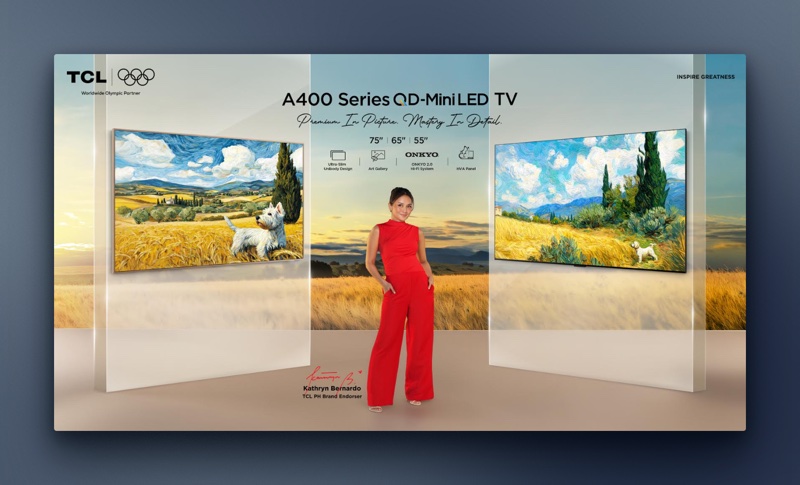
That’s the exact problem TCL is trying to solve with the new TCL A400 Series, a lifestyle TV lineup designed to look as good turned off as it does turned on.
The Problem: TVs Were Never Designed to “Fit In”
For most of TV history, design has taken a back seat to specs. Bigger screens, sharper resolutions, louder speakers — but the moment you switch the TV off, you’re left staring at a giant dark panel that clashes with everything else in the room.
As more Filipino households treat their living rooms as a personal showcase — whether that’s for content creation, hosting guests, or just everyday comfort — a TV that looks like an appliance rather than a design piece has started to feel like a compromise.
What’s New: Meet the TCL A400 Series
TCL Electronics, the No. 1 panel TV brand in the Philippines and a global leader in televisions and air conditioners, is rolling out the A400 Series in two variants: the A400M and the A400 Pro. Both are positioned as premium lifestyle TVs that blend gallery-style aesthetics with TCL’s latest display and AI technology.
According to TCL Senior Product Manager Maxi Chen, the A400 Series was built to elevate everyday home entertainment while doubling as a design centerpiece for the living room.
Related: TCL intros Curve and 4K TVs in the Philippines
Breakdown: What’s Actually Inside the A400 Series
QD-Mini LED and color performance. Both models use TCL’s QLED technology with Quantum Dot materials layered for better color accuracy. A high light-transmittance film boosts optical efficiency, which TCL says results in roughly 10% energy savings overall, while still producing over a billion color shades with precise backlighting for richer detail and contrast.
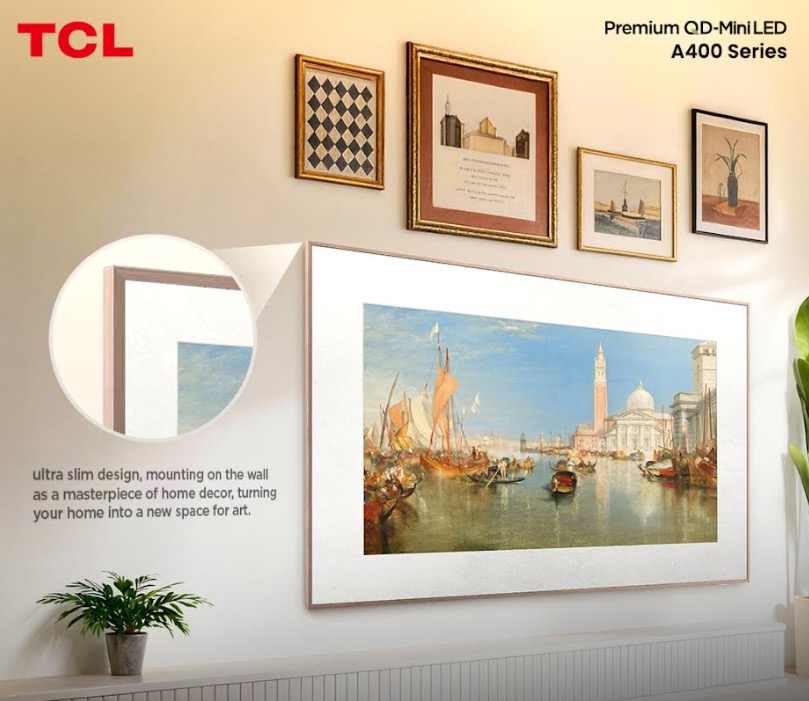
Art Gallery Mode. This is the headline feature. When you’re not watching anything, the A400 Series turns into a digital art display, pre-loaded with hundreds of well-known artworks spanning centuries of art history — plus access to over 100,000 AI-generated pieces ranging from classical styles to impressionism. Pick a style and theme, and the screen adjusts to match your space in seconds.
AI that learns over time. Powering the smarts behind the screen is TCL’s TSR AiPQ Processor, working alongside the company’s own AI model and what TCL calls its “quantum supercomputing platform” paired with the Mariana database. In practice, this means the TV continuously fine-tunes picture quality, sound, smart interactions, and even AI-assisted content — adjusting itself the more you use it, rather than relying on fixed presets.
ONKYO Hi-Fi sound. Both models come with a built-in ONKYO 2.0 Hi-Fi sound system. ONKYO has over 80 years in home theater audio and has shaped global home theater standards multiple times over, so this isn’t just a branding sticker — it’s meant to back up the “gallery” experience with sound that matches.
A400M vs. A400 Pro — what’s different? The A400M comes in a black frame with a traditional high-contrast HVA panel. The A400 Pro steps it up with a wooden frame and an anti-reflection Matte HVA panel, designed to cut glare for that true gallery-wall look.
Impact: Where to Get One
The TCL A400 Series is rolling out at authorized TCL dealers nationwide, with a twist: the A400M is exclusively available at Abenson, while the A400 Pro is exclusively available at SM Appliances. TCL hasn’t published pricing details publicly yet, so your best bet is to check with either retailer directly or visit tcl.com for updates.
Tech Patrol Insight
The “TV as art piece” concept isn’t entirely new globally, but TCL bringing it to the Philippine market — at scale, across two price tiers, with retail exclusivity deals already locked in — signals where the local TV market is heading. As more brands compete on AI features that are hard for the average buyer to evaluate (processors, “AI models,” supercomputing platforms), design and lifestyle integration are becoming the more tangible differentiator on the showroom floor.
It’s also worth watching how TCL’s continued push into AI-driven personalization — picture, sound, and now generated artwork — plays out as a long-term value proposition versus a launch-day marketing point.
Final Thoughts
A TV that doubles as a rotating art gallery is a clever pitch for Filipino homes where the living room often serves as the centerpiece of the house. The real test will be in person — how the Matte HVA panel handles glare in a bright sala, and whether the AI Art Gallery Mode feels like a genuine upgrade or just a fancier screensaver.
So, would you swap your current TV for one that becomes a digital art piece when it’s off — or is this more style than substance?