If you are contributing to the Social Security System (SSS), knowing when to stop paying is just as important as knowing how much to contribute.
This is not a simple “stop at retirement” decision. It directly affects whether you receive a lifetime monthly pension or just a one-time lump sum. The difference can reach hundreds of thousands—or even millions—of pesos over time.
In this Tech Patrol guide, we break everything down clearly by age, contribution status, and membership type so you can make a smart, strategic decision based on your situation.
Related: SSS Voluntary Contribution Guide 2025: How to Keep Your Benefits Active
- Understanding the Core Rule: Age + 120 Contributions
- If You Are 60–64 Years Old (Optional Retirement)
- If You Are 65 Years Old (Mandatory Retirement)
- What If You Are Younger Than 60?
- Employed Members
- Household Employees (Kasambahay)
- Self-Employed Members
- OFWs (Overseas Filipino Workers)
- Voluntary Members
- Non-Working Spouse
- How to Properly Stop Paying SSS Contributions
- Pension vs Lump Sum: What You Are Really Choosing
- Advanced Strategy: Maximizing Your Pension Before Stopping
- Common Mistakes to Avoid
- Final Verdict: When Should You Stop Paying SSS?
- Conclusion: Treat SSS as a Lifetime Income System
Understanding the Core Rule: Age + 120 Contributions
Your eligibility to stop paying SSS contributions revolves around two factors: your age and your total contributions.
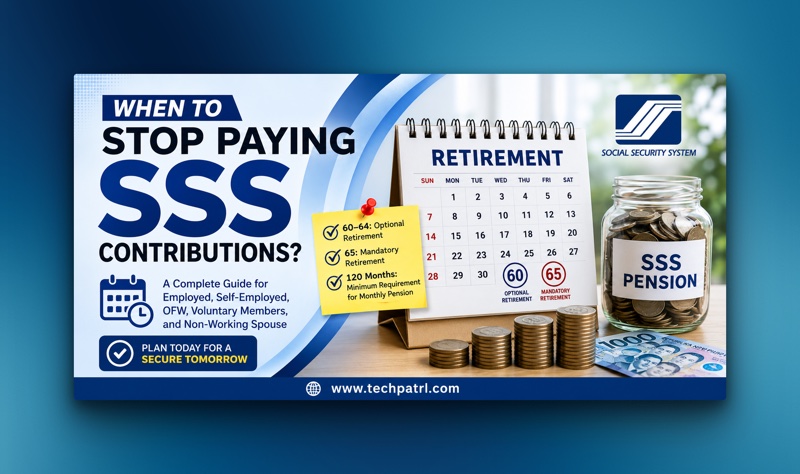
To qualify for a monthly lifetime pension, you must complete at least 120 monthly contributions (10 years).
Retirement benchmarks you must know:
- Age 60–64 → Optional Retirement
- Age 65 → Mandatory Retirement
This framework applies across all member types, but how it affects you depends on your situation.
Related: SSS unveils saving schemes with 7.2% returns to boost members’ retirement fund
If You Are 60–64 Years Old (Optional Retirement)
This is the most critical decision window.
If you already have 120 or more contributions, you can stop paying, file for optional retirement, and receive a monthly lifetime pension. At this stage, continuing contributions is optional, but doing so may slightly increase your pension if your recent salary credits are higher.
If you have less than 120 contributions, you can stop paying, but you will only receive a lump sum benefit instead of a monthly pension. This is where many Filipinos lose long-term income.
A better strategy is to continue contributing as a voluntary member until you reach 120 months. This unlocks a lifetime pension, which is almost always more valuable than a lump sum.
If You Are 65 Years Old (Mandatory Retirement)
At age 65, retirement becomes mandatory under SSS rules.
If you have at least 120 contributions, you must stop paying and file for retirement. You will receive a monthly pension.
If you have fewer than 120 contributions, you may either stop and receive a lump sum or continue contributing voluntarily until you reach the required 120 months. If you are close to the threshold, continuing is usually the smarter financial move.
What If You Are Younger Than 60?
Before age 60, the ability to stop paying depends on your membership category.
Employed Members
If you are employed, contributions are mandatory. Your employer is required to deduct and remit your SSS contributions as long as you are actively employed and below age 65.
You cannot opt out, even if you already have enough contributions. The only way to stop is to leave employment or transition to voluntary status.
Household Employees (Kasambahay)
Household employees follow the same structure as employed members. Contributions are mandatory and handled by the employer.
Payments stop only when employment ends or when retirement eligibility is reached.
Self-Employed Members
Self-employed individuals have flexibility, but stopping contributions has consequences.
You can stop anytime, but you will lose access to benefits such as loans, sickness coverage, and maternity benefits. More importantly, gaps in contributions can reduce your final pension.
The best approach is to maintain consistent contributions, especially during the last 5 to 10 years before retirement, when pension computation is most sensitive.
OFWs (Overseas Filipino Workers)
OFWs are considered voluntary contributors.
You may stop paying at any time, but doing so reduces your eligibility for benefits and may lower your pension.
Many OFWs maximize their SSS benefits by contributing during their highest earning years and choosing higher contribution brackets.
Voluntary Members
Voluntary members have full control over their contributions.
You can start or stop anytime, but consistency is key. Gaps in contributions lower your Average Monthly Salary Credit (AMSC), which directly affects your pension.
If you are nearing retirement, increasing your contribution level and maintaining steady payments can significantly improve your pension outcome.
Non-Working Spouse
A non-working spouse can contribute under their partner’s SSS membership.
Although contributions are optional, the same retirement rules apply. You must still reach 120 contributions to qualify for a monthly pension.
This option is often overlooked but can be valuable for long-term financial security.
How to Properly Stop Paying SSS Contributions
For most voluntary, self-employed, and OFW members, there is no formal process required to stop paying.
You simply stop generating a Payment Reference Number (PRN) or stop making payments through your My.SSS account.
Formal action is only required when you are ready to claim your retirement benefit, whether as a pension or lump sum.
Pension vs Lump Sum: What You Are Really Choosing
A monthly pension provides lifetime income, including a 13th month pension and possible increases over time.
A lump sum is a one-time payout with no recurring income.
While a lump sum may seem attractive, it carries the risk of being depleted. A monthly pension provides long-term financial stability.
For most people, the goal should be to qualify for a monthly pension.
Advanced Strategy: Maximizing Your Pension Before Stopping
If you are between ages 50 and 60, this is your optimization phase.
Increasing your contribution bracket, avoiding gaps, and maintaining consistent payments can significantly improve your pension.
SSS calculates your pension based on your credited years of service and your Average Monthly Salary Credit. Higher contributions during your final years typically result in a higher pension.
Common Mistakes to Avoid
Many Filipinos stop contributing too early after reaching 120 months without optimizing their pension.
Others ignore the importance of their final contribution years, which heavily influence pension computation.
Some choose a lump sum too quickly, sacrificing long-term income.
Another common mistake is failing to switch to voluntary status, limiting contribution flexibility.
Final Verdict: When Should You Stop Paying SSS?
If you are below 60, it is generally best to continue contributing if you can.
Between ages 60 and 64, you may stop if you already have 120 contributions, but continuing may still improve your pension.
At age 65, you should stop and claim your benefits unless you still need to complete the 120-month requirement.
Conclusion: Treat SSS as a Lifetime Income System
SSS is not just a mandatory deduction. It is a long-term income system designed to support you throughout retirement.
Stopping too early can reduce your benefits, while contributing strategically can significantly increase your lifetime income.
The most effective approach is to stay consistent, reach the 120-month requirement, and optimize your contributions before making the decision to stop.