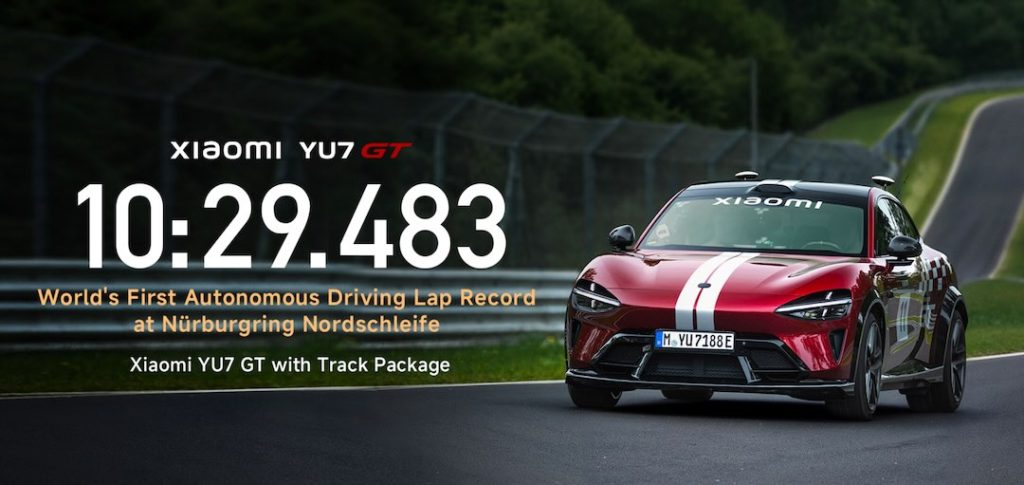
On June 23, a Xiaomi YU7 GT drove 20.8 kilometers around one of the world’s most dangerous race tracks entirely on its own. No human at the wheel. No safety driver. Just pure autonomous driving software handling 73 corners, 300 meters of elevation change, and tire-shredding grip changes that would make most drivers break into a sweat. The lap time: 10:29.483. The certification: Official, according to Nürburgring’s own timing systems.
This isn’t marketing theater. Nürburgring just created a new official category for this—AUTONOMOUS DRIVING (under ELECTRIC VEHICLES)—because no car had ever done it before. That matters. But here’s what matters more for you in the Philippines: this is how autonomous driving evolves. Not in parking lots. Not in perfect weather on empty highways. On a track where losing focus for one corner means disaster.
- Why Filipinos Need to Pay Attention Right Now
- What Exactly Happened at Nürburgring?
- The Technical Layer:
- How Xiaomi’s Autonomous Driving Actually Works
- The Architecture Breakthrough
- Why This Approach Is Different
- Why This Achievement Actually Matters
- 1. Autonomous Driving Just Proved It Works Beyond Theory
- 2. Chinese Tech Companies Are Now Leading in Autonomous AI
- 3. This Is Data Collection at Scale
- 4. It Signals Where Autonomous Driving is Headed
- What This Means for Philippine Drivers
- The Tech Patrol Take
- What Happens Next
- Stay Updated on Xiaomi’s Tech Moves
- Additional Resources
Why Filipinos Need to Pay Attention Right Now
Xiaomi doesn’t operate in the Philippines yet as an EV maker. But they own 754 million phones globally, they’ve shipped over 1 billion IoT devices, and they’re aggressively building the “Human × Car × Home” ecosystem that includes electric vehicles. This achievement signals that Xiaomi’s AI ambitions aren’t just smartphone camera tricks—they’re willing to stake their autonomous driving credibility on extreme conditions.
Here’s the local angle: if Xiaomi enters the Philippine EV market in the next 3-5 years, autonomous driving features could be part of the package. This Nürburgring lap is proof that the underlying technology works when conditions are brutal. That’s the engineering validation you don’t get from press releases.
More broadly, this shows that artificial intelligence has crossed a threshold. We’re not talking about theoretical self-driving capability anymore. We’re talking about a Chinese tech company’s AI system handling real physics, real risk, and real consequences. For a market like the Philippines that’s watching global EV adoption closely, this is a marker of where the technology actually stands.
What Exactly Happened at Nürburgring?
The Nürburgring Nordschleife is 20.8 kilometers of unforgiving asphalt. It’s not a test track—it’s a real road that’s been turned into a track, with run-off areas designed to punish mistakes. 73 corners. Elevation changes that create different grip conditions on every section. Weather that can change mid-lap. This is where automakers send prototypes to find what breaks.
On June 23, 2026, Xiaomi sent a YU7 GT fitted with the “Track Package”—a configuration designed specifically for this challenge—and let Xiaomi HAD (Xiaomi’s autonomous driving system) have the wheel. The car completed the full circuit. Nürburgring’s official timing verified the lap at 10:29.483.
The Technical Layer:
- Full autonomy: Steering, acceleration, braking, downshifting—all handled by the AI system
- 73 corners navigated independently: No pre-programmed route, just real-time decision-making
- Variable grip conditions: The track surface changes grip levels constantly; the system had to adapt in real-time
- Speed: The lap time of 10:29 is respectably fast—not pushing the absolute limit, but fast enough to prove the system was making performance decisions, not just crawling safely
This wasn’t a single lap on a closed circuit with ideal conditions. This was a full race track circuit with complex geometry, severe consequences for errors, and conditions that change mid-drive. Nürburgring doesn’t hand out official records for hobby runs.
How Xiaomi’s Autonomous Driving Actually Works
Xiaomi HAD runs on an “end-to-end architecture”—meaning the system takes sensor data from cameras, radar, and lidar, processes it through neural networks, and outputs steering/braking commands directly. No hand-coded rules. No if-then logic trees. Pure learned behavior refined through training and real-world feedback.
The Architecture Breakthrough
In March 2026, Xiaomi upgraded to a new foundation model called MiMo-Embodied. This matters because it moves beyond “behavior imitation” (copying what human drivers do) toward actual environmental understanding and autonomous decision-making. The system doesn’t just recognize “there’s a corner ahead”—it reasons about the car’s physics, tire grip, speed, and braking distance, then decides what to do.
At Nürburgring, this meant the system had to:
- Perceive the road surface in real-time and adjust grip assumptions
- Predict how the vehicle would respond to steering inputs given current conditions
- Maintain vehicle stability through rapid direction changes and elevation shifts
- Make split-second decisions about braking points and throttle response
Why This Approach Is Different
Most autonomous driving systems handle highway driving (straight roads, predictable traffic). Nürburgring throws variables that highway automation never encounters—rapid consecutive corners, zero margin for error, and grip conditions that change every hundred meters. The system had to function at the edge of the vehicle’s physics limits.
Xiaomi’s vehicle dynamics model continuously predicts how the car will behave, then coordinates steering, braking, and power delivery to maintain stability. Under the sustained high-speed, high-load conditions at Nürburgring, this happens dozens of times per minute.
Why This Achievement Actually Matters
1. Autonomous Driving Just Proved It Works Beyond Theory
You can simulate autonomous driving software all you want in data centers. You can test it on test tracks with perfect conditions. But racing a real vehicle on one of the world’s most demanding circuits with official verification? That’s different. This proves the AI doesn’t break when conditions get extreme. That’s the engineering validation that matters to every other automaker watching.
2. Chinese Tech Companies Are Now Leading in Autonomous AI
Xiaomi isn’t Tesla. Tesla has years of real-world driving data and billions in R&D budget. But Xiaomi’s autonomous driving achievement happened faster and with a more extreme benchmark. This signals that the competition in autonomous driving isn’t just between established automakers—it’s between companies willing to invest heavily in AI infrastructure. For the global EV market, this changes the competitive landscape.
3. This Is Data Collection at Scale
Every lap around Nürburgring generates sensor data, system responses, and real-world feedback that Xiaomi can use to improve their models. The system encountered conditions that would take years to accumulate in normal driving. One Nürburgring lap is worth thousands of miles of highway testing.
4. It Signals Where Autonomous Driving is Headed
Nürburgring isn’t the end goal—it’s a proof-of-concept. If an autonomous system can handle Nürburgring’s complexity, managing highway driving, city streets, and parking is a less demanding problem. This lap represents the upper boundary of where the technology is moving. Everything else gets easier from here.
What This Means for Philippine Drivers
The short answer: You won’t see Xiaomi EVs with full autonomous driving capability in the Philippines immediately. Regulatory approval for autonomous features takes time. But Xiaomi’s entry into the Philippine EV market is probable within 3-5 years, and if they do, some level of autonomous driving capability could ship with it.
Why this matters to Filipinos:
- Xiaomi already dominates Philippine smartphone market. They know how to distribute, support, and service products here. An EV company with that infrastructure advantage is different from a startup.
- EVs are coming to the Philippines regardless. Government incentives favor electric vehicles. Traditional automakers are launching EV models. If Xiaomi enters with competitive autonomous features, that changes the playing field.
- This proves the technology actually works. You shouldn’t have to debate whether self-driving is science fiction. Xiaomi just verified it on the world’s toughest race track.
But here’s what’s important: Even if autonomous driving features reach the Philippines, the first versions won’t be full Level 5 autonomy (drive anywhere without a driver). More likely, they’ll be advanced Level 3-4 features (highway autonomous driving, parking assistance, traffic jam assist). You’ll still need to pay attention. You’ll still need to be ready to take control. But the technology will handle more of the driving than it does today.
The Tech Patrol Take
This achievement proves what we’ve suspected: autonomous driving software has crossed into practical territory. It’s not perfect. It’s not ready for every scenario. But the underlying technology is legitimate, and it works under conditions far more demanding than what consumers encounter.
What makes this different from other autonomous driving milestones is the extremity of the test. Nürburgring isn’t a controlled environment. It’s a real-world road that happens to be a famous race track. Weather changes. Grip conditions vary. The track evolves as tires wear. A system that handles Nürburgring doesn’t break on your morning commute.
The bigger story: Chinese automakers are moving faster than Western companies in autonomous driving because they’re willing to iterate quickly and test publicly. Xiaomi put their system on the world’s most famous race track and let the results speak. That confidence—whether justified or not—matters for the market.
What Happens Next
Xiaomi’s timeline for autonomous driving advancement:
- Immediate (2026-2027): More public testing and data collection to refine the system further
- Near-term (2027-2028): Broader rollout of autonomous features in Xiaomi EV models, starting with domestic (Chinese) market
- Market expansion (2028-2030): International expansion of Xiaomi EVs, likely including Southeast Asia
- Next-generation improvements: The MiMo-Embodied model will continue training on real-world data, improving handling of edge cases and bad weather
For the Philippines specifically, watch for:
- Xiaomi’s official announcement on EV market entry
- Regulatory framework updates for autonomous vehicles
- Pricing and availability timelines for Xiaomi EVs in Southeast Asia
Stay Updated on Xiaomi’s Tech Moves
This is how autonomous driving gets real—through public challenges, official verification, and companies willing to stake their reputation on the tech working. Subscribe to TechPatrol to catch the next milestone, whether it’s a different manufacturer breaking a new record or autonomous features launching in your market.
Drop a comment: Do you trust autonomous driving enough to let it handle your car? What needs to happen before you’d actually use it?
Additional Resources
Related Xiaomi Products:
Industry References: