

The VSTECS CXO Tech Summit 2026 opened its second day at Shangri-La Boracay with a blunt message from VST ECS Phils. President and CEO Jimmy Go: memory chips now fuel the AI economy the way oil fueled the industrial age, and the shortage has no end in sight.
Go addressed the ninth edition of the summit through a video message, speaking to a hall of CXOs from banking, retail, manufacturing, logistics, healthcare, real estate, BPO, and government. His core claim: 2026 is the year companies stop experimenting with AI and start demanding results from it.
For regular Filipino buyers, the bigger story sits under the boardroom talk. Go said memory and SSD prices more than doubled in recent months, consumer notebook prices rose 30 to 50 percent, and smartphone brands either raised prices or cut shipments. If the laptop you bookmarked in January now costs thousands more, this keynote explains why. Here is what Go said, what it means for your wallet, and where the Philippines fits in the global AI race.
- VSTECS CXO Tech Summit 2026 at a Glance
- Jimmy Go VSTECS Keynote: AI Has Left the Pilot Stage
- Memory Shortage Philippines: Why Your Next Laptop Costs More
- EO 119 Data Sovereignty, AWS Philippine Cloud Region, and Pax Silica
- AI Adoption Philippines: Fintech, BPO, and Healthcare
- What VSTECS Philippines Wants CXOs to Do Next
- TechPatrol Verdict
- Frequently Asked Questions
VSTECS CXO Tech Summit 2026 at a Glance
| Detail | Info |
|---|---|
| Event | VSTECS CXO Tech Summit 2026 (9th edition) |
| Organizer | VST ECS Phils., Inc. |
| Venue | Shangri-La Boracay |
| Theme | “Rethinking IT: Powering the AI-Driven Enterprise” |
| Opening address | Jimmy Go, President and CEO (via video message) |
| Vendors on hand | 100+ technology brands |
| Key warning | Memory shortage to tighten through 2027 and 2028 |
Jimmy Go VSTECS Keynote: AI Has Left the Pilot Stage
The Jimmy Go VSTECS keynote framed AI adoption as a three-year arc. Two years ago, AI was a demo. Last year, a pilot. This year, the companies pulling ahead have pushed it into production for customer service, credit scoring, demand forecasting, document processing, and software development.
Go argued that technology no longer belongs to the IT department. He called it the core driver of margin, efficiency, and scale, and warned executives that waiting for a technology to reach “100% stable” status hands the market to competitors who moved first. In his words, the greatest risk a company faces today is the illusion of safety in inaction.
He also named specific developer tools changing how software gets built, including Claude Code, GitHub Copilot, Windsurf, and Cursor. That’s a notable shift for a distributor keynote, which usually sticks to hardware and enterprise licensing.
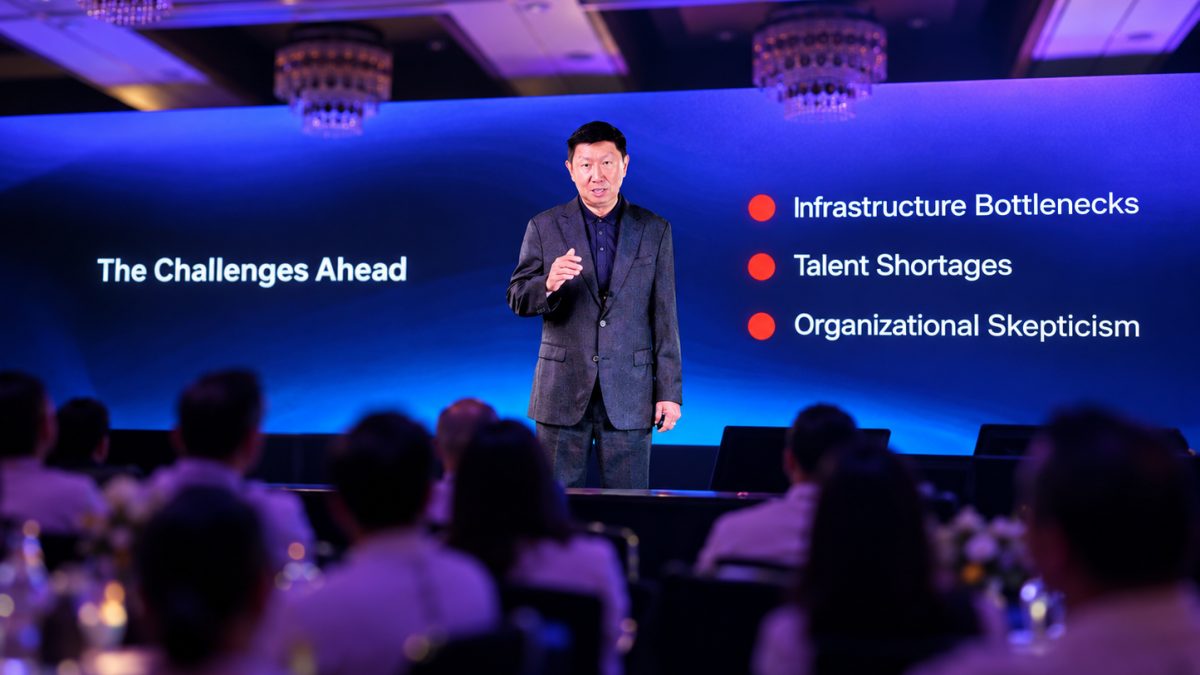
Then came the reality check, and it came from Go himself. He cited data showing only 2% of firms have scaled AI beyond pilots, with infrastructure bottlenecks, talent gaps, and organizational skepticism holding the rest back. So “2026 is the year of results” is the goal, not the scoreboard. For most local companies, AI still lives in a slide deck.
Memory Shortage Philippines: Why Your Next Laptop Costs More
This is the part of the speech every gadget buyer should read. Go described high-bandwidth memory (HBM) and server DRAM as the bottleneck of the AI boom. AI data centers consume far more memory than traditional workloads, and hyperscalers like Amazon, Google, and Microsoft are buying it first.
The ripple effects he listed hit consumers directly:
- Servers and storage: Allocation shifted to hyperscalers. Server DDR5 prices rose nearly 100% quarter on quarter, and many enterprise rollouts slipped into 2027.
- PCs and notebooks: Brands cut shipments, redesigned configurations, and in some cases downgraded specs. Consumer notebook prices rose 30 to 50 percent.
- Smartphones: Rising component costs forced brands to raise prices or trim targets. Go cited an IDC projection of a 13% drop in global smartphone sales in 2026.
That explains the RAM price increase Philippines shoppers have seen at PC shops along Gilmore and in online stores. It also explains laptop prices Philippines 2026 buyers keep complaining about, and why some mid-range models ship with less RAM than last year’s version at a higher SRP.
Smartphone prices Philippines 2026 follow the same logic. Phones need LPDDR memory and UFS storage, and both now compete with AI servers for factory capacity.
The Micron memory shortage 2027 outlook backs Go’s warning. On Micron’s fiscal 2026 earnings call, CEO Sanjay Mehrotra said supply and demand will be tighter in both 2027 and 2028 than in 2026, and that more than 75% of Micron’s 2027 output is already committed. He admitted the company has no visibility on when the market returns to balance.
Go noted the pace of price hikes has slowed. Slower increases still mean higher prices, though. Nobody on that stage promised a return to 2024 pricing.
EO 119 Data Sovereignty, AWS Philippine Cloud Region, and Pax Silica
Go spent a section of the keynote on local policy and investment. He pointed to three developments:
EO 119 data sovereignty. Go said President Bongbong Marcos approved EO 119, which updates the government’s data classification framework and data residency policy. He framed it as a trust foundation that pushes investment into local data centers and creates jobs for Filipino tech talent.
AWS Philippine cloud region. Go said AWS is reportedly planning a $5 billion investment to set up a Philippine cloud region. A local region means lower latency for Filipino apps and an easier path for banks and government agencies that must keep data in the country.
Pax Silica Initiative. Go described this as a national push to move the Philippines from exporting raw ore to processing materials locally and building semiconductor and AI infrastructure.
Together, these make the Philippines a more serious destination for AI infrastructure money. Execution remains the question. Data centers need stable power, and rural areas still struggle with connectivity, a gap Go acknowledged in the same speech.
AI Adoption Philippines: Fintech, BPO, and Healthcare
Go backed his AI adoption Philippines argument with sector numbers:
- Fintech: GCash, Maya, and other players use AI credit scoring to extend loans to 12 million Filipinos without formal banking history. Platforms like Trusting Social and JuanHand analyze telco and e-wallet data, opening ₱55 billion in nano-loans. Approvals drop from days to minutes.
- BPO: AI in BPO Philippines now handles 75 to 85% of routine call center interactions, cutting costs by up to 65% while raising satisfaction scores by 13 points. Go said Filipino agents are shifting into “CX Architect” roles that handle complex and emotionally sensitive calls. He placed industry revenue at $42 billion a year.
- Healthcare: With only 4 doctors per 10,000 Filipinos, AI diagnostic and clinical support tools are under pilot in underserved regions.
The BPO numbers matter most here. Call centers employ well over a million Filipinos. Go’s line, that AI won’t replace Filipino talent but talent using AI will replace talent that doesn’t, reads as a warning to every agent who hasn’t touched an AI tool yet.
What VSTECS Philippines Wants CXOs to Do Next
VSTECS Philippines positions itself between global brands and hundreds of local resellers, integrators, and enterprises. Go said that vantage point shows what gets deployed, what stalls, and what gets bought and never used.
His closing ask to CXOs: treat the technology roadmap as corporate strategy, let teams experiment and fail fast, and build organizations modular enough to pivot overnight. The summit’s mix of plenary sessions, fireside chats, breakouts, and vendor booths is VSTECS’s pitch that no company should attempt this alone. It is also, plainly, a sales floor for the 100+ brands VSTECS distributes.
TechPatrol Verdict
Strip away the leadership language and this keynote carries one hard number for consumers: memory costs doubled and suppliers expect worse. Micron’s own guidance confirms it. If you need a new laptop or phone for work or school, waiting for prices to drop looks like a losing bet through 2027. Buy what you need now, prioritize RAM and storage over flashy extras, and avoid paying more for downgraded configs.
On the AI side, Go’s optimism comes with an honest footnote. Only 2% of firms have scaled AI past pilots. The Philippines has the policy and investment headlines. Now it needs power, connectivity, and trained workers to match.
Frequently Asked Questions
What is the VSTECS CXO Tech Summit 2026? It is the ninth edition of VST ECS Phils.’ annual executive technology conference, held at Shangri-La Boracay under the theme “Rethinking IT: Powering the AI-Driven Enterprise.”
What did the Jimmy Go VSTECS keynote say about AI? Go said 2026 marks the shift from AI experimentation to production results, while noting only 2% of firms have scaled AI beyond pilot projects.
Why is there a memory shortage Philippines buyers are feeling? AI data centers consume huge amounts of HBM and server DRAM, so manufacturers prioritize hyperscalers. Go said memory and SSD prices more than doubled, pushing up laptop and phone prices.
Will laptop prices Philippines 2026 go down soon? Unlikely. Micron’s CEO said memory supply will be tighter in 2027 and 2028 than in 2026, with over 75% of its 2027 output already committed.
What is EO 119 data sovereignty? According to Go, EO 119 updates the Philippine government’s data classification framework and data residency policy, encouraging local data centers and data sovereignty.
Is there an AWS Philippine cloud region? Go said AWS is reportedly planning a $5 billion investment to establish one. Treat it as reported, not confirmed, until AWS makes a formal announcement.


