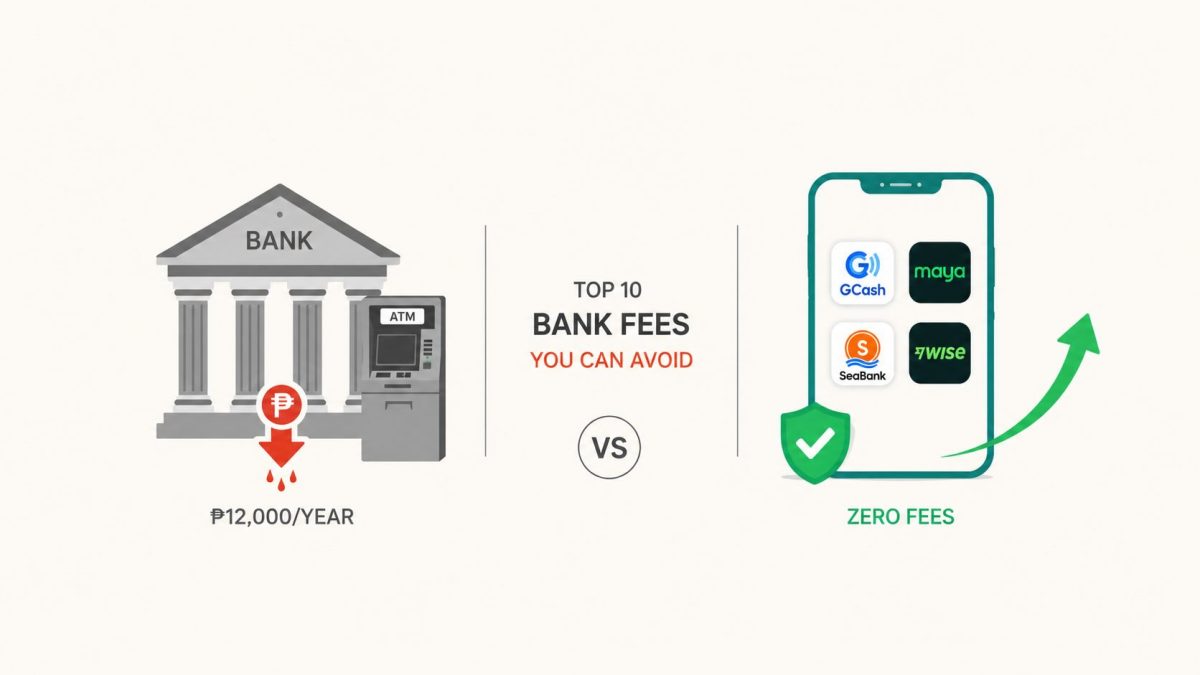
Your traditional Philippine bank account is quietly draining thousands of pesos every year. Between transfer surcharges, off-network ATM penalties, balance maintenance fees, foreign transaction markups, and credit card annual charges, most Filipino account holders lose ₱300 to ₱800 monthly to charges that fintech solved years ago.
The good news: digital banks and fintech platforms have weaponized technology to kill these fees. Apps like SeaBank, Maya, GCash, and Wise now offer free interbank transfers, zero ATM charges, no balance requirements, and cashback on international purchases—features that traditional banks still gatekeep behind premium tiers or refuse to offer at all.
This guide maps the top 10 most painful Philippine bank fees and shows you exactly which digital banking apps and fintech solutions eliminate each one. If you’re moving ₱50,000+ annually through Philippine banks, or making international purchases, or carrying credit cards, switching to digital banking could save you ₱3,600 to ₱9,600 per year.
- 1. Interbank Transfer Fees (InstaPay & PESONet): Save ₱6,000/Year
- 2. Off-Network ATM Charges: Skip the ₱1,000+/Year Leak
- 3. Minimum Balance Penalties: Trap ₱300-₱1,000/Month
- 4. Over-the-Counter and Regional Processing Fees: Eliminate ₱50-₱100/Transaction
- 5. Account Dormancy Penalties: ₱30-₱500/Month Until Zero
- 6. Early Closure Fees: The ₱200-₱2,000 Trap
- 7. Paper Document and Statement Fees: ₱100-₱300 Per Request
- 8. Foreign Transaction and Currency Conversion Fees: ₱3,000-₱5,000/Year
- 9. Credit Card Annual Fees: ₱500-₱2,000/Year for Unused Cards
- 10. Overdraft and Insufficient Funds Charges: ₱500-₱1,000+ Per Incident
- The Fintech Stack That Eliminates All 10 Fees
- How Much You’re Actually Losing to Fees
- The Switch: Why It Takes Longer Than It Should
- Start Today: Four Quick Wins
1. Interbank Transfer Fees (InstaPay & PESONet): Save ₱6,000/Year
The Hit: ₱10 to ₱25 per transfer between different banks.
If you’re topping up GCash weekly, sending money to friends across different banks, or feeding a Shopee/Lazada habit, this fee compounds fast. Doing five transfers per week costs ₱50 to ₱125 weekly—or ₱2,600 to ₱6,500 annually.
The Fix:
- SeaBank offers three free InstaPay/PESONet transfers monthly; every transfer after that costs ₱5. Their app is lightweight and works on older Android devices (API 24+).
- Maya (formerly Paymaya) bundles unlimited free InstaPay transfers with their core app—no premium tier required.
- GCash provides free transfers to other GCash users and waived InstaPay fees if your GCash balance exceeds ₱50,000.
- Wise handles international transfers without Philippine domestic surcharges, useful if you’re sending money abroad or receiving remittances.
The strategy: Route high-frequency transfers through GCash or Maya first, then batch remaining transfers into one weekly PESONet hit. Most Filipinos can cut transfer fees to ₱0 to ₱5 monthly just by switching this one habit.
2. Off-Network ATM Charges: Skip the ₱1,000+/Year Leak
The Hit: ₱10 to ₱18 per withdrawal; ₱1.00 to ₱2.50 per balance check at competitor ATMs.
Checking your balance at a non-network machine before withdrawing costs ₱20 per trip. Do this weekly and you’ve burned ₱1,000 annually on convenience.
The Fix:
- Stop using ATMs entirely. Digital banking apps kill this fee structure overnight. Check your balance in-app (free, instant), and pay everything via QRPh or debit card.
- SeaBank and Maya let you withdraw cash at any BDO, GCash partner, or convenience store (7-Eleven, SM, Robinson’s) without surcharges. Maya’s network is the widest—you can withdraw at 25,000+ locations nationwide.
- GCash converts to cash at any 7-Eleven, Puregold, or Robinsons for free if you have enough balance.
Modern Filipino commerce doesn’t require cash. If you absolutely must withdraw, use your digital bank’s partner network to avoid the fee entirely.
3. Minimum Balance Penalties: Trap ₱300-₱1,000/Month
The Hit: ₱300 to ₱1,000 monthly if your average daily balance (ADB) drops below the required minimum.
Traditional banks calculate ADB across the entire month, not just the final day. Missing the minimum for two consecutive months triggers recurring penalties until your account hits zero—a silent killer for freelancers and gig workers whose balances fluctuate.
The Fix:
- Move to zero-ADB digital banks. SeaBank, Maya, GCash, and Wise have no balance requirements whatsoever. Your money sits in these apps earning interest or staying untouched without penalty.
- Open a Basic Deposit Account (BDA) at your traditional bank if you need one. BDAs require ₱100 minimum, not ₱2,000 to ₱10,000.
- Stop using traditional checking accounts entirely. Digital banks are faster, cheaper, and built for Filipino payment flows.
For most users, this single switch saves ₱300 to ₱1,000 monthly.
4. Over-the-Counter and Regional Processing Fees: Eliminate ₱50-₱100/Transaction
The Hit: ₱50 to ₱100 per OTC deposit or withdrawal outside your account’s registered region; ₱100+ for teller service on small amounts.
Traveling for work? Visiting family in Visayas or Mindanao? Your traditional bank charges regional surcharges on top of the transaction itself.
The Fix:
- Use Cash Accept Machines (CAMs) at your bank instead of teller service. CAMs don’t incur regional processing fees.
- Route deposits through digital banking apps. GCash accepts cash-in at any partner outlet (7-Eleven, Puregold, Robinson’s). Maya does the same. No regional surcharge, no teller required.
- Mobile deposits via your bank’s app (photograph-based check deposits) skip the teller entirely.
This eliminates regional fees almost completely. One transaction outside your home region saved per month = ₱600 to ₱1,200 annually.
5. Account Dormancy Penalties: ₱30-₱500/Month Until Zero
The Hit: Accounts inactive for one to two years get flagged as dormant. Banks then charge monthly maintenance fees until the account is completely drained.
Opening accounts for job requirements, loan applications, or one-time transactions is normal—but forgetting to close them later is expensive.
The Fix:
- Digital banks make account closure instant. SeaBank and Maya let you close accounts directly in the app with zero fees. No branch visit, no forms, no penalties.
- Perform at least one transaction per year on every open account you want to keep. A ₱10 transfer every 12 months resets dormancy timers.
- Use digital banks for temporary accounts. Need a quick holding account for a freelance gig or side project? Open SeaBank or Maya. Close it anytime.
Most users with multiple traditional bank accounts are bleeding ₱30 to ₱500 monthly across dormant accounts they forgot about. Switching to digital banking and closing unused accounts stops this leak immediately.
6. Early Closure Fees: The ₱200-₱2,000 Trap
The Hit: Closing a traditional bank account within 90 days of opening triggers administrative penalties (₱200 to ₱2,000).
Banks designed this fee to punish account-opening arbitrage and prevent fraud. But it also punishes Filipinos who open accounts for temporary needs.
The Fix:
- Digital banks have zero early closure fees. Close SeaBank or Maya anytime without penalty.
- Avoid traditional banks for temporary needs. Every one-time account costs ₱200+ to close early.
- Keep newly opened traditional accounts for 90+ days if you must use them.
If you open even two traditional bank accounts annually for temporary needs, switching to digital banking saves ₱400 to ₱4,000 per year.
7. Paper Document and Statement Fees: ₱100-₱300 Per Request
The Hit: Traditional banks charge ₱100 to ₱300 for printed Statements of Account (SOA) and ₱150 to ₱300 for physical Bank Certificates.
Visa applications, loan underwriting, and credit card applications often require official documentation. Requesting paper copies adds administrative fees.
The Fix:
- Opt into electronic Statements of Account (eSOA). Download them free from your mobile app anytime. Most institutions accept digital SOAs now.
- Request e-certified documents instead of printed ones. Many banks now issue digitally signed certificates through online banking portals at no cost.
- Screenshots and PDF exports suffice for most modern lenders and visa processors. Verify with your destination institution before requesting paid documents.
This is one of the lower-impact fees on the list, but if you request paper documents twice yearly for loans, visas, or credit applications, you’re spending ₱600+ annually on something that costs banks pennies to produce.
8. Foreign Transaction and Currency Conversion Fees: ₱3,000-₱5,000/Year
The Hit: Traditional banks charge 2% to 3% markup on every foreign transaction, plus ₱150 to ₱300 per overseas purchase or withdrawal.
If you’re shopping on Amazon, paying for international SaaS tools, or traveling abroad, your traditional bank’s Visa or Mastercard is bleeding you dry. A ₱10,000 purchase in USD gets marked up ₱200 to ₱300 just from currency conversion. Do this five times monthly and you’ve burned ₱1,000 to ₱1,500 on forex spreads alone.
The Fix:
- Wise card (formerly TransferWise) offers real mid-market exchange rates with zero markup. International purchases cost just the real spot rate—no hidden conversion fees. Annual fee: ₱0. Wise also lets you hold 50+ currencies and spend from any account instantly.
- Maya offers international transactions with competitive forex rates (typically 1% markup versus traditional banks’ 2-3%). Many overseas retailers accept Maya for online shopping.
- GCash and Paymaya also provide international payment options, though rates aren’t as transparent as Wise.
For Filipinos buying from international retailers, paying for cloud hosting, or traveling abroad monthly, switching to Wise alone saves ₱3,000 to ₱5,000 annually. This is one of the highest-impact fees on this list.
9. Credit Card Annual Fees: ₱500-₱2,000/Year for Unused Cards
The Hit: Traditional banks charge ₱500 to ₱2,000 yearly just to hold a credit card, even if you use it once.
Filipinos often hold multiple credit cards for rewards programs, sign-up bonuses, or employer requirements. But most see no benefit and pay annual fees anyway—a silent leak that compounds across three to five cards.
The Fix:
- Ditch traditional credit cards. Digital banking apps like Maya and GCash offer cashback and rewards without annual fees. Maya Mastercard users earn 1-2% cashback on purchases; GCash has similar programs.
- Request annual fee waivers from your bank if your card is dormant. Many banks waive fees for customers who maintain a high average balance or make frequent transactions.
- Close cards you don’t use. If your bank won’t waive the fee and you’re not earning rewards, close it. Period.
- Use installment features cautiously. Some digital banks like Maya offer installment plans (0% interest for 3-6 months) on large purchases without annual card fees.
Most Filipinos could eliminate ₱2,000 to ₱4,000 yearly in credit card fees just by consolidating to one active card (or moving to digital banking entirely) and closing the rest.
10. Overdraft and Insufficient Funds Charges: ₱500-₱1,000+ Per Incident
The Hit: Overdrawing your account by even ₱1 triggers overdraft fees of ₱500 to ₱1,000, plus daily interest until you cover the deficit.
A single accidental overdraft on a traditional bank account can cost ₱800 to ₱1,500. If this happens once yearly (and it happens to many Filipinos), that’s ₱800 to ₱1,500 wasted on a momentary cash flow gap.
The Fix:
- Digital banks have zero overdraft fees. SeaBank, Maya, and GCash simply reject transactions if your balance is insufficient. No surprise charges. No interest. No fees.
- Link a backup digital bank account. Many digital banking apps auto-transfer from a linked account if primary balance drops below zero. This prevents overdraft altogether.
- Set up low-balance alerts. All digital banks notify you when your balance hits ₱500, ₱1,000, or a threshold you set. No surprises.
- Avoid overdraft “protection.” Traditional banks offer this as a feature, but it’s a trap. Just use digital banking instead.
For freelancers, gig workers, and anyone with variable income, this switch alone prevents ₱800 to ₱1,500 in annual overdraft penalties.
The Fintech Stack That Eliminates All 10 Fees
Here’s a practical setup for most Filipino tech users:
| Task | App | Cost |
|---|---|---|
| Daily spending & QRPh payments | GCash or Maya | Free |
| Interbank transfers | Maya or SeaBank | Free (limited) or ₱5/month |
| Savings (zero ADB) | SeaBank or digital bank | Free |
| Cash withdrawals | GCash/Maya partner network | Free |
| International purchases & forex | Wise card | Real mid-market rate (0% markup) |
| Rewards & cashback | Maya or GCash | 1-2% cashback (no annual fee) |
| Overdraft protection | Any digital bank | Free (no overdraft fees) |
| Monthly statements | All digital banks | Free (electronic) |
Most Filipinos can go completely cashless and fee-free by keeping ₱500 minimum in GCash, ₱1,000 in Maya, and one digital savings account. Traditional bank accounts become unnecessary except for payroll requirements.
How Much You’re Actually Losing to Fees
Let’s do the math for an average Filipino with a traditional bank account, regular international spending, and multiple credit cards:
Scenario 1: Domestic-Only User
- Interbank transfers (5/week): ₱300/month = ₱3,600/year
- Off-network ATM checks & withdrawals (2/week): ₱150/month = ₱1,800/year
- Below-ADB penalties (₱2,000 minimum required): ₱200/month (2 months) = ₱2,400/year
- OTC regional fees (1/month): ₱75/month = ₱900/year
- Paper document requests (2/year): ₱300/year
- Credit card annual fees (2 cards unused): ₱1,000/year
- One overdraft incident: ₱800/year
Subtotal: ₱10,800 to ₱14,000/year
Scenario 2: International Shopper or Freelancer
- All of the above, plus:
- Foreign transaction markups (₱10,000/month in USD purchases at 2.5%): ₱3,000/year
- International transfer fees: ₱1,200/year
Total annual fee bleed: ₱12,000 to ₱18,000+ for someone with international payments, multiple cards, and variable income.
Switching to digital banking and fintech can cut this to ₱300 to ₱600 annually. That’s ₱11,400 to ₱17,700 back in your pocket every year.
The Switch: Why It Takes Longer Than It Should
Despite digital banks being faster, cheaper, and frankly better than traditional banks, adoption in the Philippines lags because:
- Employer payroll requirements. Many companies still mandate traditional bank accounts for salary deposits. This won’t change overnight.
- Loan and mortgage gatekeeping. Traditional banks still require their own accounts for lending. You often need both.
- Legacy user behavior. Millions of Filipinos grew up with physical banks and distrust app-only systems.
The realistic approach: Keep a traditional bank account for payroll (if required) and one major financial institution. Route everything else—spending, transfers, savings—through digital banking apps. This hybrid model cuts fees by 80% while maintaining employer and lender access.
Start Today: Four Quick Wins
- Download Maya or GCash today. Transfer ₱5,000 and eliminate interbank transfer fees from your next five transactions. Savings: ₱50 to ₱125 immediately.
- Stop using ATMs. Check your balance in-app. Withdraw only from 7-Eleven, Puregold, or SM via GCash/Maya. Savings: ₱150 to ₱200 monthly.
- Close dormant accounts and consolidate credit cards. Log into your traditional bank, close unused accounts and credit cards before dormancy or annual fees hit. Keep one primary card maximum. Savings: ₱30 to ₱500 monthly per account, plus ₱500+ annually from card fees.
- Switch international purchases to Wise. If you shop on Amazon, pay for cloud hosting, or buy SaaS annually, apply for a Wise card today. Your forex savings pay for the app in one purchase. Savings: ₱3,000+ annually if you do ₱10,000+ in foreign currency transactions yearly.
These four changes cut your annual bank fee burden by 75% to 90% within 30 days.