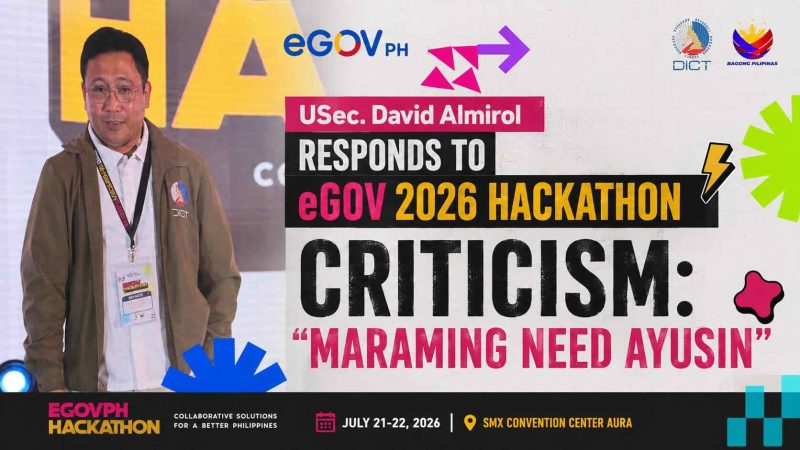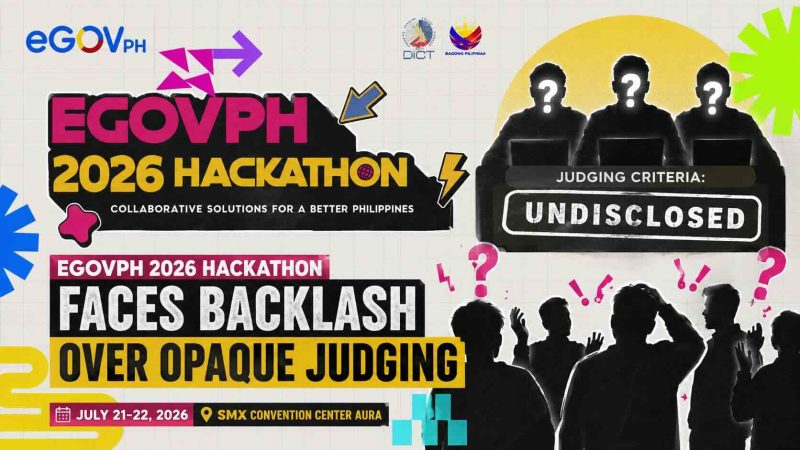
The eGov Hackathon Top 30 finalists will each receive ₱100,000, and Undersecretary David Almirol has finally shown the math behind who made the cut and why the original judging process broke down.
Weeks after developers Renz Tegrado and Bryl Lim called out the eGov 2026 Hackathon for opaque judging and inconsistent results, Almirol posted a full breakdown of the competition’s entries on Facebook. The numbers confirm what participants suspected all along, and the DICT team is now rolling out a revised process to fix it.
The Numbers Nobody Had Before
Out of 137 registered five-man teams, only 106 actually submitted an entry. Thirty-one teams registered and never followed through.
| Category | Count |
|---|---|
| Teams registered | 137 |
| Teams with entries | 106 |
| Teams without entries | 31 |
| Presented working system + eGov API integration | 46 |
| Presented existing system, no eGov API integration | 34 |
| Presented idea via PowerPoint only | 26 |
| Top 30 finalist prize | ₱100,000 each |
| Final winners | 5 (MOU with DICT eGov) |
The number that matters most here is 26. That’s how many teams advanced through evaluation with nothing more than a slide deck, no working system, no product screenshots, no code. They competed directly against 46 teams that built and integrated actual eGov APIs overnight.

This is exactly what Renz Tegrado flagged in his original post. “How does a team without a working prototype, apparently presenting only a PowerPoint without even product screenshots, place ahead of teams that spent the entire night building and testing functional applications?” he asked at the time.
Almirol had already partially answered that in an earlier response, admitting that judges “based [decisions] on submitted presentation materials… instead of the technicalities and developed technology itself” because they had only three hours to review 137 entries. This new post shows the actual scale of that shortcut: close to a quarter of all valid submissions skipped building anything at all.
What Changes From Here
Almirol laid out a three-step process for the remaining evaluation:
Step 1: Technical Q&A for API-integrated teams. The 46 teams that built systems with real eGov API integration will go through 1-on-1 technical sessions with the eGov team. This is the group most affected by the earlier judging gap, and it’s the first sign of a more hands-on evaluation.
Step 2: Top 30 Finalists announced. Each finalist receives ₱100,000, following what Almirol described as a more thorough technical evaluation based on official hackathon criteria.
Step 3: 5 winners selected from the Top 30. These teams get the opportunity to sign a Memorandum of Understanding with the DICT E-Government Office, with terms discussed individually per team.
This sequencing directly answers the transparency complaint Bryl Lim raised in his original post, when organizers announced a Top 10 while claiming other evaluations were still ongoing. This time the order is explicit: technical review, then finalists, then winners.
Why This Matters for Filipino Developers
The eGov Hackathon isn’t just a weekend contest. It’s tied to a ₱2 million prize pool, personally backed by First Lady Liza Marcos and Almirol himself, and it’s meant to feed real solutions into government digital services.
Almirol was direct about the stakes in his update: “The primary purpose of the eGovHackathon is not just a contest – it’s a serious hunt of several impactful solutions that could bring government services more efficient and accessible.”
That framing raises the bar for what “winning” should actually require. If the goal is deployable solutions, not just pitch decks, then the judging process has to reward the 46 teams that built working systems over the 26 that didn’t build anything.
What’s Coming Next
Almirol confirmed that a national eGovHackathon is already being planned, with three proposed team categories: individual, duo, and team of 5. The next iteration carries a new tagline: “Compete. Collaborate. Build solutions that matter.”
He closed with a mix of exhaustion and resolve: “I’m jaded but hopeful.”
The Verdict
This update doesn’t erase the frustration from the first eGov Hackathon, but it’s the clearest sign yet that the criticism landed. The data confirms the core complaint, roughly a quarter of advancing entries had no working product, and the new process at least attempts to fix the exact gap developers pointed out.
Whether the Top 30 and final 5 actually reflect working technology over polished slides is the real test. TechPatrol will track the announcement as it happens.