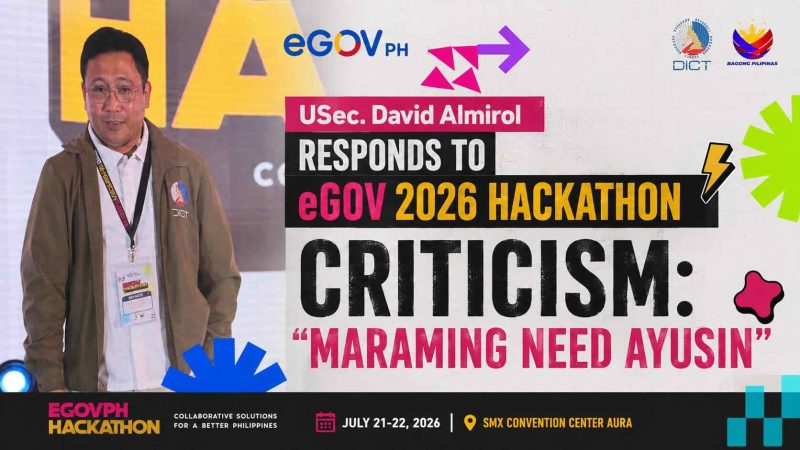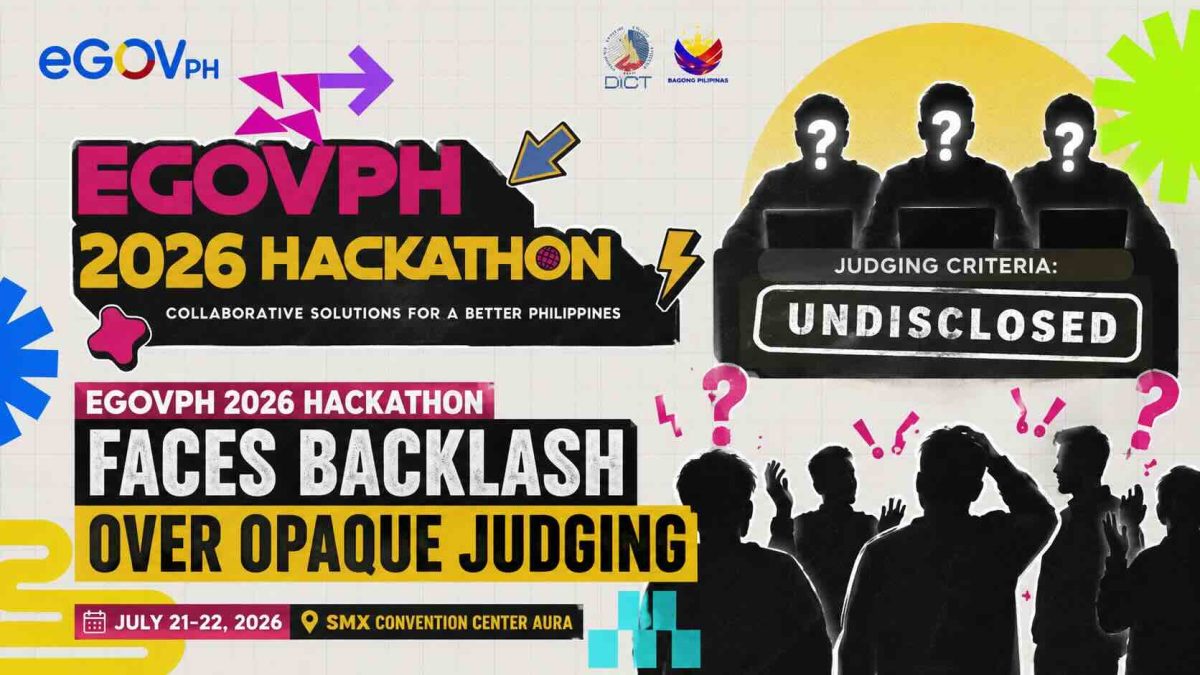
Developers criticize lack of transparency in ₱2 million prize pool distribution, inconsistent organizer feedback, and poor event logistics.
Developers Renz Tegrado and Bryl Lim are calling out the eGov 2026 Hackathon for opaque judging, questionable winner selection, and poor logistics. The event, backed by ₱2 million from First Lady Liza Marcos and Undersecretary David Almirol, presented itself as a showcase for Filipino builders and the eGov platform’s open APIs. Their Facebook posts detail specific failures that undermined the competition’s credibility.
The Core Problem: Judging Without Transparency
The most damaging criticism centers on the judging process itself. With a ₱2 million prize pool distributed across Top 10 teams (₱100,000 each) and Top 30 teams (₱50,000 each), organizers never disclosed scoring breakdowns or ranking methodologies.
“The judging process was not transparent. We still do not know the scoring breakdown or how the rankings were decided,” Bryl wrote. “With that level of support and investment, I believe the judging process should be fully transparent.”
The lack of clarity became more troubling when organizers announced the Top 10 finalists while claiming they were still evaluating remaining submissions. Bryl flagged the logical inconsistency: “As a participant, it is difficult to understand how the Top 10 could already be final if not everyone had been fully evaluated yet.”
Winners That Don’t Make Sense
The judging decisions themselves raised questions about consistency and innovation.
Renz highlighted that four of the winning projects were essentially healthcare platforms presented in different forms, despite organizers repeatedly emphasizing the need for “more creativity.” “If healthcare was the priority, the event might as well have been called the eGov Health Hackathon,” he wrote.
More puzzling: one winning entry was described as “effectively another version of Sakay.ph,” the existing public transport app. This is particularly telling because one of the hackathon panelists explicitly told participants on Day 1 to stop making traffic apps—yet another traffic-related solution won anyway.
Renz summed up the contradiction: “Make it make sense.”
The Working vs. Non-Working Problem
The most damaging revelation: at least one winning team presented only a PowerPoint concept without a working prototype, while teams that built functional applications throughout the night ranked lower.
“How does a team without a working prototype, apparently presenting only a PowerPoint without even product screenshots, place ahead of teams that spent the entire night building and testing functional applications?” Renz asked.
He described the experience of staying awake to ensure his team’s mobile app would function flawlessly: “Seeing a non-working concept outperform functional prototypes was deeply discouraging.”
This directly contradicts what a hackathon should be. The term itself—from “hack” and “marathon”—implies building, not just ideating. Teams compete by creating working code and shipping functional prototypes, not by presenting polished concepts.
The Elephant in the Room: eGov Platform Duplication
There’s also an uncomfortable problem with USec. Almirol’s own remarks. After each Top 10 demo, he mentioned that “a similar feature or product already existed within eGov in some form,” according to Bryl.
This creates a fundamental question: if the winning solution already exists within the platform, what made it innovative enough to win? Were teams being judged on novelty, technical execution, or something else entirely?
The vagueness of the answer reflects the broader lack of transparency.
Logistics Failed Too
Beyond judging, the event itself was poorly organized.
Registration was chaotic, with announced schedules not being followed. The hackathon didn’t start until around 5 PM despite a full day available. Bryl described the experience: “Teams spent a lot of time waiting without knowing what would happen next.”
The impact was visible in the drop-off between Day 1 and Day 2 attendance. “The disappointment was visible in the event itself. Just compare the number of attendees on the first day with the number who returned on the second,” Renz wrote.
A Missed Opportunity for Filipino Builders
Both developers emphasized that their criticism was not directed at eGov’s mission or the platform itself. “Kudos to the eGov team for building a great platform, opening their APIs to developers, and continuing to push digitalization forward,” Bryl noted.
The issue is execution. Hackathons should inspire builders and leave participants excited to join again. This one did the opposite.
Bryl was particularly blunt about the outcome: “I have decided that this will be my last government hackathon.”
He also warned about the message being sent to student participants: “I genuinely hope this experience does not become their idea of what a hackathon is supposed to be.”
Community Reaction: A Pattern of Broken Trust
The criticism extends far beyond Renz and Bryl’s posts. Other developers across social media have voiced similar frustrations, revealing a pattern of broken trust in government hackathons.
“This is exactly why I don’t join hackathons like this anymore,” one developer posted. “Either the judges suck at judging or organizers suck at organizing. Sometimes, both happen. There are many talented Filipino devs. I hope people honor them by giving a proper, organized competition.”
The lack of transparency is a key sticking point. Another developer expressed outright skepticism of the process: “I don’t believe in the government’s process. Tsk. Kahit saan lang din. Sino ba yung panel?” The question—who even sits on the judging panel—underscores how little information was disclosed to participants.
A third developer noted that concerns were spreading through developer communities: “Nakita ko rin yung mga participants nag-post sa isang group page related to these concerns. It’s so sad to see these issues for a Hackathon Event. Hindi dapat ganito, dapat lahat clear and transparent. This is really alarming. Yes, we are not anti-eGovPH, we believe their skills and initiatives pero sana next time hindi na ‘to mauulit.”
The last quote is particularly telling. Developers aren’t opposed to supporting government digitalization efforts. They’re frustrated that poor organization and opaque judging are wasting the opportunity to work with talented Filipino builders who genuinely want to contribute.
Even developers who chose not to participate saw the problems coming. Bert Azura Padilla, a DX leader and technopreneur, decided to skip the hackathon after spotting red flags early. “There were already too many red flags—from incomplete details and online registration issues to timelines that felt more like a rushed sprint than an event requiring months of careful preparation,” he posted.
Padilla’s decision looks prescient in hindsight. But his post also reveals what the hackathon could have been if organizers had gotten the basics right.
“The talent is here. The interest is here,” he wrote. “What builders need now is clearer planning, transparent processes, and an environment that respects their time, effort, and ideas.”
Padilla acknowledged the strength of eGov’s underlying platform and vision—the Digital Government Roadmap is “genuinely promising and impressive.” The problem wasn’t the mission. It was the execution of a single event that squandered developer goodwill and participation.
What Needs to Change
Both developers outlined specific fixes:
- Transparent judging criteria announced upfront, with detailed scoring breakdowns disclosed after results
- Consistent evaluation standards across all submissions
- Respect for participant time through organized logistics and clear timelines
- A focus on building working prototypes, not just pitching ideas
Renz concluded with a direct challenge: “The submissions did not need ‘more creativity.’ The competition needed clearer judging criteria, consistent standards, and transparency in how winners were selected. And most importantly, this was supposed to be a hackathon, not an ideathon.”
What’s Next
Organizers have not responded to these criticisms. Given the government’s investment in digitalization and developer support, the eGov team needs to address these concerns before the next event.
Developers won’t return to a hackathon that rewards ideas over execution, or where judging is a black box. The prize pool is irrelevant if the competition isn’t fair.