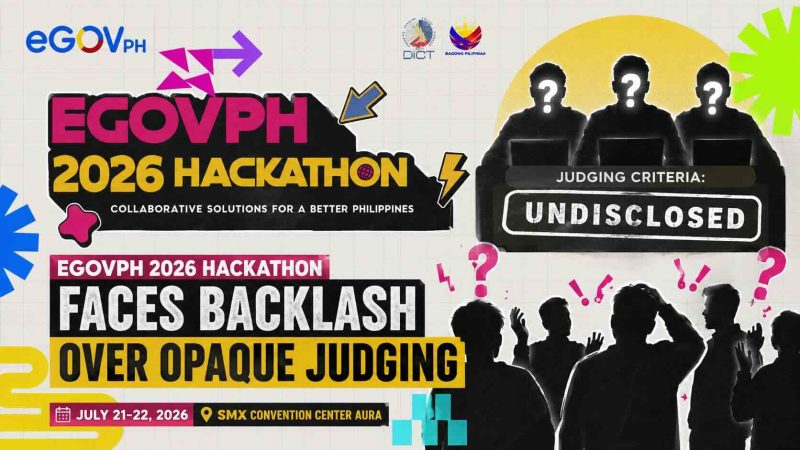
In a candid Facebook post, the DICT Undersecretary for E-Government owns up to registration mishaps, a rushed judging process, and government procurement delays—while defending the hackathon’s intent and outlining fixes for next time.
Following widespread criticism from participants over opaque judging and poor logistics at the eGov 2026 Hackathon, Undersecretary David Almirol has broken his silence with an unusually direct and self-critical response.

In a lengthy Facebook post, Almirol acknowledged the event’s flaws point by point, offered explanations rooted in government bureaucracy, and admitted personal frustration with the process he helped create.
“Not Perfect, Daming Need Ayusin”
Almirol opened by acknowledging the hackathon fell short. “The very first eGovHackathon! Not perfect, daming need ayusin next time, but the clear intention to seriously engage the IT community is there to jointly improve government services closer to the people,” he wrote.
He said the goal was never just a competition. “I’ve seen hackathons in the past pero hanggang dun lang, parang competition lang at usapan ng kung sino mananalo. But what we need is to really implement these solutions to the government.”
This context matters. According to Almirol, the reason full winners haven’t been announced is that the eGov team plans to sit down individually with each Top 30 team for technical meetings, with implementation as the goal rather than just recognition.
Owning the Judging Failures
Almirol addressed the transparency criticism directly, revealing new details about what went wrong behind the scenes.
He explained that he intentionally stayed out of the evaluation process to avoid bias, delegating judging to external parties instead. But this created a different problem: with only three hours to review 137 entries during the eGovTalks session, judges reportedly based decisions on submitted presentation materials rather than the actual technical execution.
“Kaso we missed the point of relevance, nag base sila sa na submitted na presentation materials… instead of the technicalities and developed technology itself,” Almirol admitted.
This directly validates the core complaint from Renz Tegrado and Bryl Lim: functional prototypes were evaluated on the same footing as pitch decks, explaining how non-working concepts could outrank working applications.
Almirol said he will personally evaluate the Top 30 to select five winners, with results expected the following week. He’s also considering a system where the IT community itself judges future hackathons.
The Bureaucracy Behind the Chaos
Perhaps the most revealing part of Almirol’s post is his account of internal government obstacles that shaped the event’s execution.
Registration: Almirol wanted to automate registration, but government documentation rules required manual signatures from participants for accounting and audit purposes. “How frustrating… kaya nga may technology, di ba??” he wrote.
Procurement: Materials and preparations for the hackathon were delayed because the procurement process only concluded the week before the event. Almirol called for simplifying procurement for small-scale needs like this.
Budget: There was no official line-item budget for the hackathon. The ₱3 million+ event cost, covering venue, food, lights, sound, materials, and personnel, came from savings. Sponsors contributed roughly ₱100,000, mostly in T-shirts and gift certificates. Almirol personally committed ₱1 million to the prize pool, which First Lady Liza Marcos matched with another ₱1 million during the event itself.
Almirol also noted that a formal request for ₱100 million has been submitted for next year to properly support developers, integrators, and local startups.
Volume Nobody Anticipated
Almirol said the team was not prepared for the response. More than 1,500 registrants and 250+ teams signed up in under a week, forcing organizers to decline many applicants.
His proposed fix for future events: an extended format with at least one week for development and another full week for evaluation, replacing the overnight build-and-judge model that clearly did not work for hundreds of entries.
What This Means for the Criticism
Almirol’s response does not erase the concerns raised by participants, but it does contextualize them. Several complaints are directly confirmed by his own account:
- Judging based on decks, not code — validated by his own admission about the evaluation process
- Poor registration experience — attributed to inflexible government audit requirements, not organizer negligence
- Rushed timeline — a byproduct of procurement delays outside the eGov team’s direct control
- Unclear winner announcements — explained as a deliberate choice to prioritize implementation meetings over quick awarding, though this rationale was never communicated to participants during the event
That last point remains a gap. Whatever the reasoning, participants were left confused in real time, precisely the kind of communication failure that fueled the backlash in the first place. Good intentions do not substitute for clear communication before and during an event.
A Rare Moment of Government Accountability
Public officials rarely respond to criticism this directly, and Almirol’s willingness to name specific failures, government processes, and his own frustrations is notable. He closed his post with a personal note of exhaustion and a Bible verse, Galatians 6:9, encouraging persistence despite setbacks.
Whether this translates into a genuinely improved eGovHackathon 2.0 remains to be seen. Almirol has committed to fixes: community-led judging, extended timelines, simplified registration, and dedicated budget planning. Filipino developers who felt let down by the first event now have a checklist to hold the DICT team accountable to next time.
TechPatrol will continue following this story as the Top 30 evaluations and the promised Hackathon 2.0 details are announced.
This article is a follow-up to TechPatrol’s previous coverage on developer criticism of the eGov 2026 Hackathon’s judging and logistics.