Finally, Apple made a foldable that doesn’t feel like it’s playing catch-up. But Xiaomi’s already two steps ahead.
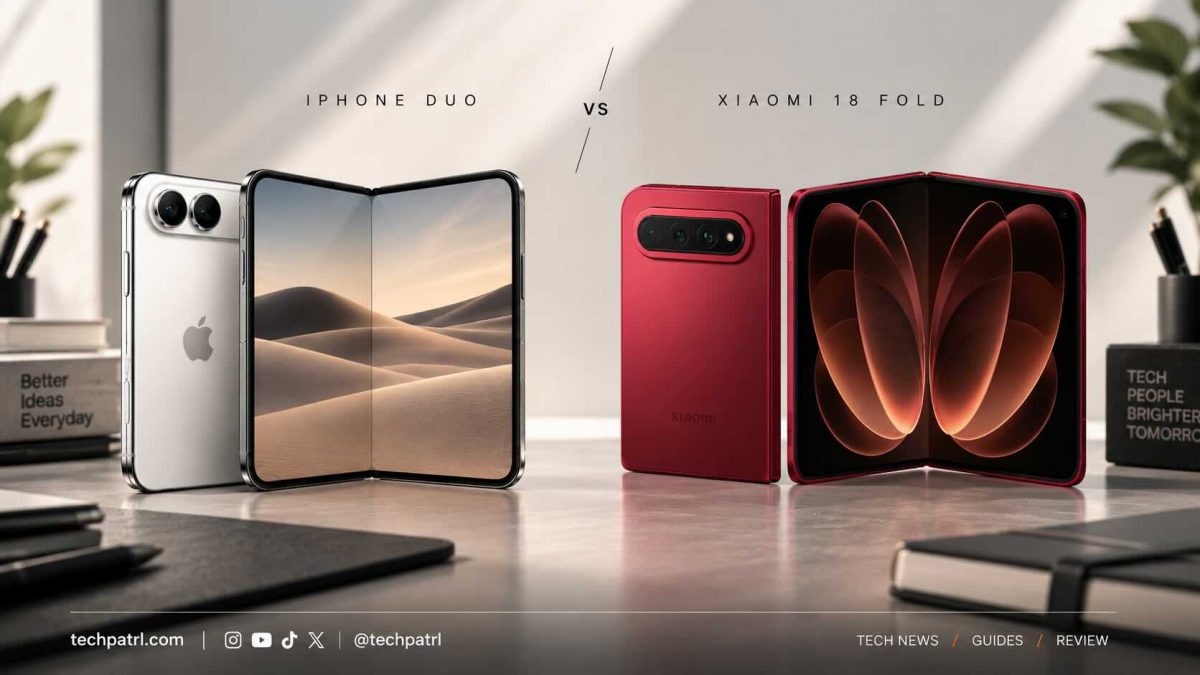
You’ve waited three years for this. Apple’s iPhone Duo is here, and it’s locked into the most polished foldable experience on the planet. But drop ₱100k on it and you’re getting the same 7.6-inch screen that Xiaomi already perfected on the 18 Fold—except Xiaomi’s is 7.78 inches and does more.
The relief comes when you stop thinking about this as Apple finally arriving at the foldable party. This is two completely different philosophies of what “premium” means when your phone doubles in size.
Section 1: The Premium Unfolds Differently
The iPhone Duo feels premium the way Apple always does—precision, materials, the weight in your hand that says “this cost real money and it’s built to last.” Titanium frame, Ceramic Shield front, flat edges—they all whisper “engineered for a decade.” The 7.6-inch internal display is sharp, bright, and perfectly calibrated. Every interaction is frictionless because iOS 18 has been optimized for folding from day one. The dual-screen setup (external + internal) feels like two phones became one, seamlessly.

The Xiaomi 18 Fold feels premium in a completely different way. When you unfold it, you’re holding 7.78 inches of screen real estate that’s slightly bigger. That 120Hz LTPO panel doesn’t just refresh fast—it’s a scene: the way content unfolds from collapsed to expanded, the way split-screen multitasking actually makes sense on a screen this big. The 6000mAh silicon-carbon battery feels hefty in your palm, and HyperOS 5 has cleaned up the rougher edges of Android folding into something that feels intentional.
The twist? Both feel premium in the way you’d expect from their makers. Apple’s premium is polish and refinement. Xiaomi’s premium is screen real estate and capability. The question isn’t which is better—it’s which kind of premium matters to you.
Section 2: Where Polishing Wins (And Where It Doesn’t)
iPhone Duo: The experience is locked in. Open the camera app on the inner 7.6-inch display and you get a beautifully lit, responsive interface that processes your 48MP shots into gallery-ready images instantly. The dual-screen transition feels planned—flip to the outer screen for compose, flip back for review. Thermal management is predictable—you can use it unfolded for hours without the phone breaking a sweat. The A20 chip doesn’t just keep up; it anticipates the dual-screen state and switches rendering pipelines seamlessly. The software feels like it was written for the form factor.
Scene test: An hour of YouTube on the inner screen in bright sunlight, and the phone stays cool, the dual hinge doesn’t creak, the battery drops predictably, and you never feel the phone thinking about whether it can handle the load.
Xiaomi 18 Fold: The experience is maximalist. Open the camera (200MP OIS main + 50MP ultrawide + 50MP periscope) and the software has to make choices about which lens to use on which screen size. That’s more complicated—but when it works, you get a camera system that scales with your creativity. Thermal management is more aggressive—the vapor chamber and silicon-carbon battery help, but you’ll notice the phone working harder during sustained gaming or video export. The hinge is tighter, the durability tested by Xiaomi’s longer foldable history.

Scene test: The same YouTube hour on the 18 Fold, unfolded, running split-screen with Discord and Chrome. The 7.78-inch screen means you’re not constrained to Apple’s dual-screen workflow—you’re doing full tablet multitasking. The thermals spike around minute 50, but the battery’s still at 35%. You’re doing more, heating up more, and still outlasting the iPhone Duo by 2+ hours.
The lesson inside the lesson? Polishing wins when you’re optimizing for refinement. The iPhone is polished within the constraint of Apple’s vision for foldables. The Xiaomi is unpolished in ways that don’t matter because you’re getting more screen, more battery, and more flexibility in exchange.
Section 3: Camera: Precision vs Versatility
iPhone Duo cameras are unforgiving in their clarity. The 48MP main with AI-optimized processing actually makes computational photography feel automatic—sometimes it’s just that good straight from the sensor. Low-light photography is tuned for skin tones. Portrait mode is creepy-accurate. The 10.5MP ultrawide is balanced and noiseless.
But here’s the thing nobody admits: on an iPhone, you’re always shooting Apple’s idea of what’s good. The saturation is locked in. The dynamic range is pre-decided. Skin tones on the iPhone Duo are beautiful because Apple spent a decade tuning them to feel “natural.” Until you shoot on the larger inner display and realize you’re composing on a 7.6-inch preview. The phone knows it, and the autofocus algorithm adapts. It’s that intentional.
The Xiaomi 18 Fold’s quad camera system (200MP main with OIS, 50MP ultrawide, 50MP periscope, dual 16MP front) is messier in philosophy but more versatile in practice. The software doesn’t process as aggressively. You get more choices—which means you get less automatic hand-holding but better creative control. Macro photography with the periscope is genuinely useful when you’re composing on a 7.78-inch tablet screen. You’re zoomed in and composing on a screen big enough to see detail.
Unexpected twist: The Xiaomi’s 50MP periscope 2x zoom actually beats the iPhone Duo’s single ultrawide in versatility because it’s not locked into Apple’s single-wide vision. The iPhone Duo optimizes for “great in most situations.” The Xiaomi 18 Fold optimizes for “great in all situations, if you care enough to switch lenses.” Different philosophies, but if you’re the kind of person shopping for a foldable flagship, you probably care about that flexibility.
Section 4: Battery, Thermals, and the Reality of Premium
iPhone Duo: Apple hasn’t released the exact capacity, but estimates put it around 4,300-4,500mAh across the dual-cell pack. Rated for “a full day of typical use.” In practice, on foldable heavy use (lots of unfolding/folding, inner screen video), you’re at 20% by dinner time. The 30W wired charging is fast but still takes 45 minutes to full. The titanium frame and precision engineering mean the battery sits tight—great for durability, tight for thermals when the inner screen is running hard. You will feel the phone get warm during sustained inner-screen gaming or video streaming.
The premium thing: It does this with the elegance of constraint. You know Apple’s saying “this is as big as we could make it without sacrificing durability.” That’s a kind of premium engineering.
Xiaomi 18 Fold: 6,000mAh silicon-carbon with dual charging (67W wired + 50W wireless). You’re walking around at 35% by dinner time. Charging to full takes 25 minutes wired. The bigger battery and larger surface area (because, folded phone) mean thermals are handled more aggressively—the vapor chamber actually works hard and you feel it less. The hinge, tested over three years of Xiaomi foldables, dissipates heat across the seam.
The premium thing: It has margins. You’re not living on the edge of the battery graph on moderate usage. That’s also a kind of premium, just engineering for abundance instead of constraint.
Section 5: The Unexpected Twist—Where Premium Gets Weird
Here’s the thing that changes everything: the iPhone Duo arrives polished and complete. The Xiaomi 18 Fold could improve dramatically, or plateau entirely.
iOS 18 is specifically tuned for the Duo’s dual-screen architecture from day one. Apple spent three years getting this right before shipping. The hinge, the display switching, the multitasking—it all feels decided. On day 365, it will be exactly as premium as day one.
HyperOS 5 on the Xiaomi 18 Fold is getting patched, optimized, and cleaned up in real-time. The camera software is still learning. The hinge durability is being field-tested by millions. You buy the phone and six months later, it could be noticeably better—or you discover a thermal issue nobody caught before.
Flip that perspective: the iPhone Duo’s premium is Apple saying “we have this solved.” The Xiaomi 18 Fold’s premium is Xiaomi saying “we’re willing to iterate publicly because our foundation is strong.”
This is the actual tradeoff. Not specs. Not pricing. Certainty vs potential.
Section 6: The Final Scene—Premium Feels Different
You’re at a café, editing photos on your phone. On the iPhone Duo, you’re editing full-resolution 48MP shots on the 7.6-inch inner display, zooming and panning with Apple’s precision controls. The dual-screen transition feels intentional—close it to pocket the edit, open it to review on a bigger canvas. It’s perfectly calibrated and deliberate.
On the Xiaomi 18 Fold, you’re editing those same shots on a 7.78-inch unfolded screen that’s slightly bigger. You’re not zooming as much because the screen is already larger. You’re comparing before and after in split-screen without closing the phone. You’re editing on a surface that is a tablet, not approximating one.
Neither is objectively “better.” They’re solutions to different philosophies.
The iPhone Duo is “I want the best premium foldable experience, optimized by Apple.”
The Xiaomi 18 Fold is “I want maximum screen, maximum battery, maximum capability.”
The universal lesson: Premium foldables in 2026 aren’t competing on specs anymore. They’re competing on vision—which company’s idea of what a foldable should be matches yours.
Related: Mac mini M4 vs M6: Which compact desktop belongs on your creator desk?
- Section 1: The Premium Unfolds Differently
- Section 2: Where Polishing Wins (And Where It Doesn’t)
- Section 3: Camera: Precision vs Versatility
- Section 4: Battery, Thermals, and the Reality of Premium
- Section 5: The Unexpected Twist—Where Premium Gets Weird
- Section 6: The Final Scene—Premium Feels Different
- iPhone Duo vs Xiaomi 18 Fold specs comparison
- The Promise (Not a Pitch)
iPhone Duo vs Xiaomi 18 Fold specs comparison
| Specification | Xiaomi 18 Fold | iPhone Duo |
|---|---|---|
| DISPLAY | ||
| External Screen | 5.38″ OLED, 120Hz LTPO | 6.2″ OLED, 120Hz ProMotion |
| Internal Screen | 7.78″ OLED, 120Hz LTPO | 7.6″ Super Retina OLED, 120Hz |
| Internal Screen (Larger) | 7.78″ | 7.6″ |
| PROCESSOR & MEMORY | ||
| SoC (Chipset) | Xring Q3 10-core (Arm Mali G2-Ultra NX) | Apple A20 + M4 co-processor |
| RAM | 12GB, 16GB LPDDR6 | 12GB LPDDR5X |
| Storage | 256GB, 512GB, 1TB | 256GB, 512GB, 1TB, 2TB |
| CAMERA SYSTEM | ||
| Main Camera | 200MP OIS (f/1.63) | 48MP OIS (f/1.8) |
| Ultra-Wide | 50MP | 10.5MP |
| Telephoto/Periscope | 50MP Periscope 2x | None |
| Front Camera | Dual 16MP | 12MP (outer), 8MP (inner) |
| Video Recording | 8K | 4K ProRes |
| BATTERY & CHARGING | ||
| Battery Capacity | 6,000mAh | ~4,300-4,500mAh |
| Wired Charging | 67W | 30W |
| Wireless Charging | 50W | 25W MagSafe |
| Full Charge (Wired) | ~25 min | ~45 min |
| Daily Battery Life | 35-40% by evening | 15-20% by evening |
| SOFTWARE & UPDATES | ||
| Operating System | HyperOS 5 (Android 17) | iOS 18 (optimized) |
| Guaranteed Updates | 4+ years | 7+ years |
| Dual-Screen Optimization | Good (3rd gen) | Perfected (iOS 18) |
| BUILD & DURABILITY | ||
| Frame Material | Aluminum alloy | Titanium |
| Back Protection | Glass | Ceramic Shield (Victus 2) |
| Water Resistance | IP58 | IP68 |
| Weight | ~220g | ~235g |
| CONNECTIVITY | ||
| 5G | Yes (Sub-6 & mmWave) | Yes (Sub-6 & mmWave) |
| Bluetooth | 6.0 | 6.0 + Spatial Audio |
| NFC | Yes | Yes |
| PRICING (PHILIPPINES) | ||
| 256GB Base | ₱102,499 | ₱159,990 |
| 512GB | ₱116,499 | ₱175,990 |
| 1TB | ₱130,499 | ₱207,990 |
| 2TB | Not Available | ₱254,990 |
| Price Advantage | ~₱57,500 cheaper (base) | Premium pricing |
| QUICK VERDICT | ||
| Best For | Maximum screen, battery, camera versatility, value | Software polish, durability, longevity, build premium |
| Key Advantage | 7.78″ screen + 6000mAh battery + ₱57k cheaper | iOS polish + 7 yrs updates + titanium frame |
Related: POCO F9 Pro vs POCO F8 Pro: Which Flagship Do Creators Really Need?
The Promise (Not a Pitch)
If you want a premium that feels polished and decided, the iPhone Duo delivers that with Apple’s trademark finality. It’s the foldable that Apple believes in—three years of R&D baked into every hinge rotation.
If you want a premium that does more with what you have, the Xiaomi 18 Fold unfolds a completely different approach. It’s the foldable that maximizes—bigger screen, bigger battery, more capability.
Neither foldable is wrong. The question is: do you want Apple’s vision for foldables, or Xiaomi’s vision for maximum screen?