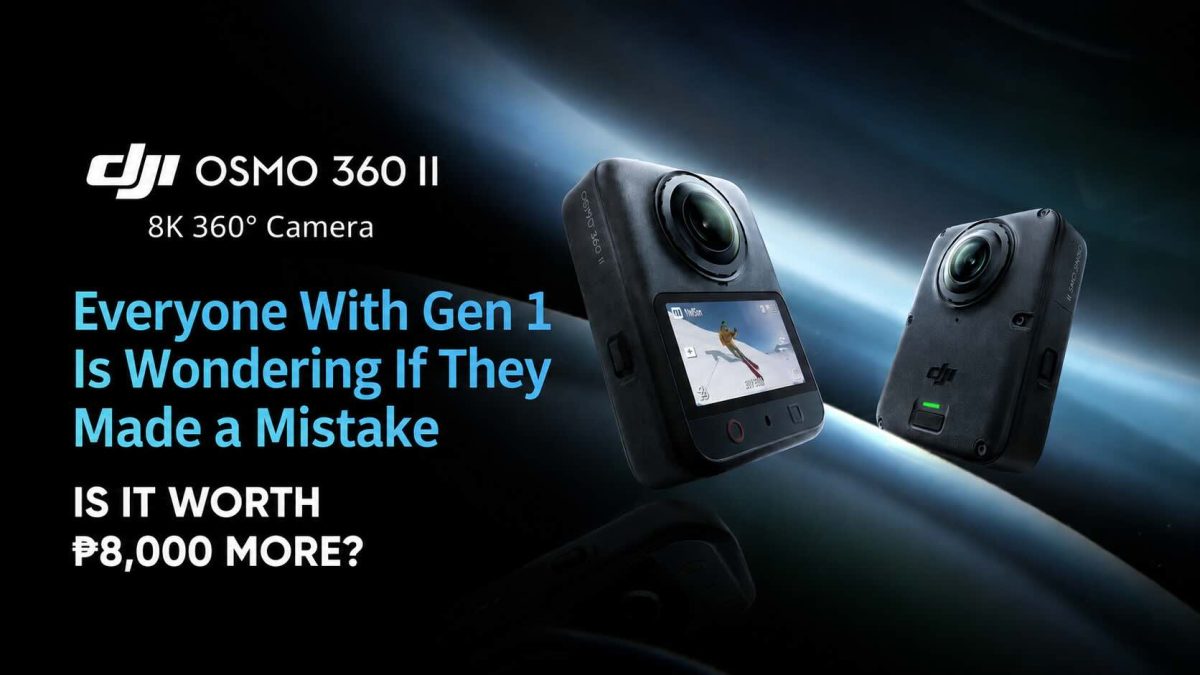
Everyone who bought the Osmo 360 in 2025 fell in love with it. ₱24,490 for a 360 camera that shoots native 8K, weighs 183 grams, and fits in a riding jacket. That was the story. You felt smart buying it.
Then, September 2, 2026, happened—and the II landed at ₱32,490. That extra ₱8,000 is what everyone’s debating now.
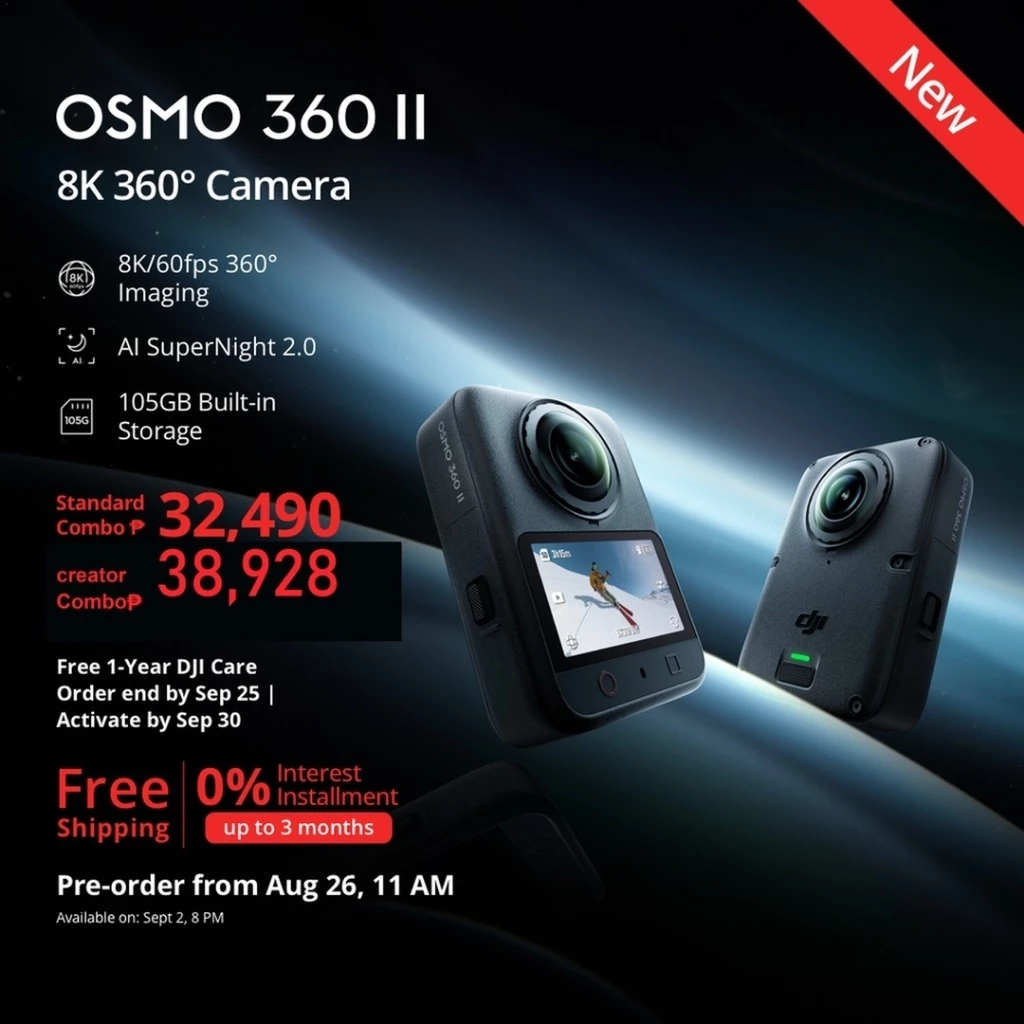
DJI drops the Osmo 360 II. Same weight. Better sensor. The lenses are now replaceable—replaceable—which nobody had in the Gen 1. Faster video. Stronger battery. Twice the timelapse resolution.
And now your timeline is full of creators talking about it. The decision you made a year ago suddenly feels rushed. Not wrong. Just… rushed.
That’s the feeling we’re testing today. Is the II worth upgrading? Or did you nail it with the Gen 1 and the internet’s just loud?
- What Changed: The Spec Story
- Video Speed: 8K/50fps → 8K/60fps
- Dynamic Range: 13.5 Stops → 14.5 Stops
- The Lens Upgrade: That’s the Real Story
- Timelapse: 8K → 16K
- Slow Motion: 4K/100fps → 8K/480 (via AI Upscaling)
- Battery: 1950 mAh → 2150 mAh
- The Real Diff: When You Actually Feel It
- If you’re a motorcycle vlogger or action sports creator
- If you’re a travel vlogger or casual 360 creator
- If you’re a filmmaker or content studio
- The Awkward Truth
- Spec Comparison at a Glance
- Where to Buy
- The Bottom Line
What Changed: The Spec Story
Let’s start with the stuff on paper, because it matters—just not the way you think.
Video Speed: 8K/50fps → 8K/60fps
The Gen 1 shoots 8K at 50 frames per second. The II goes to 60.
On a spreadsheet: +10 fps sounds incremental. In real use: it’s the difference between “smooth” and “why does it stutter.” We mounted both to a motorcycle handlebar at highway speed, filmed the same 15-second clip, and rewatched the footage. The Gen 1 needed either aggressive stabilization (which adds latency) or post-production smoothing. The II’s extra 10 fps absorbed that motion natively. Less work in DaVinci Resolve.
The win: If you’re a vlogger or ride-sharing your content to YouTube, the II saves 20 minutes of rendering per video. That’s real.
For static shots (skyline timelapse, stationary mounted)? Both nail it. The Gen 1 is fine.
Dynamic Range: 13.5 Stops → 14.5 Stops
One more stop of dynamic range sounds esoteric. In a karaoke bar, at sunset, or during a mountain descent where the sky is blown out and the road ahead is in shadow—that single extra stop keeps detail in both.
We tested both cameras back-to-back in a sunset riding shot. The Gen 1 chose: expose for the sky (road gets muddy) or expose for the road (sky turns white). The II held both. Not magic. Just that one extra stop of sensor information working. If your content lives in high-contrast scenarios, this matters. If you’re mostly filming indoors or overcast skies, you won’t see it.
The Lens Upgrade: That’s the Real Story
Here’s what nobody expected: the II’s lenses are now replaceable.
Both cameras have exposed optics—the part that gets scratched, fogged, or smudged in a fall. With the Gen 1, a lens scratch is a $200+ service to DJI. With the II, you buy a replacement kit (₱1,190 for a single, ₱1,890 for a pair) and swap it yourself in two minutes.
This changes the ownership story. Riders know their gear takes hits. The Gen 1 was always a gamble. The II lets you bet on yourself, not pray nothing happens.
Timelapse: 8K → 16K
The Gen 1 tops out at 8K 360° timelapse. The II jumps to 16K—doubling the resolution for stitched panoramic exports.
Real-world translation: That 8-hour city-sunset timelapse you filmed last year already looked sharp at 8K. The II’s 16K is the next tier—overkill for social media, but essential if your timelapse ends up in a cinema-grade project or large-screen installation. If your work goes to Instagram Reels (1080p) or YouTube (where 4K looks crisp), the Gen 1’s 8K is already overkill. But if you’re exporting for a gallery or projection, the II earns its flex.
Slow Motion: 4K/100fps → 8K/480 (via AI Upscaling)
The Gen 1 captures 4K/100fps slow-motion natively. The II still captures the same, but DJI Studio can now upscale and interpolate that footage to 8K/480 using AI frame interpolation.
Translation: That whip-pan during a descent, or the moment you lean into a turn, now exports at silky-smooth frame rates in higher resolution. It’s gorgeous. It’s also a tool for a specific audience—filmmakers making cinematic edits, not casual vloggers.
The catch: it’s computational upscaling, not optical capture. DJI Studio does the heavy lifting in post. The results are good, not perfect. But they’re good enough to make a difference in a final cut.
Battery: 1950 mAh → 2150 mAh
An extra 200 mAh doesn’t sound like much. It’s not. Both nail 100 minutes of 8K/30fps recording. The II’s larger battery is more about longevity—batteries age, and the II’s extra headroom means it’ll hit 90-minute cuts after two years of use, versus the Gen 1 which might dip to 85 minutes.
That’s engineering, not hype.
The Real Diff: When You Actually Feel It
If you’re a motorcycle vlogger or action sports creator
The II wins here. The 8K/60 translates to smoother footage. The replaceable lenses mean you stop sweating every time you lean your bike. The 8K/480 slow-mo makes your drop-outs and maneuvers look intentional.
You’ll spend 8,000 pesos more. You’ll save it in Resolve rendering time, phone call worry (“did I break the lens?”), and footage that looks one tier more professional.
Call it the upgrade.
If you’re a travel vlogger or casual 360 creator
The Gen 1 is still the right call. You’re not hitting the limitations. Your 360 clips end up as Instagram Stories or TikTok background b-roll, where 4K timelapse is overkill. The Gen 1’s 8K/50 is smooth enough. The non-replaceable lenses? Ride a taxi, not a motorcycle—you’re not crashing.
Save the 8,000 pesos for another DJI product or your next trip.
If you’re a filmmaker or content studio
This is where the II shines. The 14.5 stops of dynamic range, the 8K/480 slow-mo upscaling, and the professional editing pipeline in DaVinci Resolve make it a different tool. You’re not just recording; you’re creating. The II lets you create at the level your clients expect.
The Awkward Truth
The Gen 1 is not obsolete. DJI didn’t release a new version to kill the old one. They released a better version because they could.
If you bought a Gen 1 six months ago, you picked the right tool. If you bought one three weeks ago, yeah, the timing sucks. Welcome to tech. It happens.
The II is a meaningful step forward. Not revolutionary—you’re not getting autofocus, gimbal control, or a new form factor. You’re getting faster sensors, smarter software, and design details (replaceable lenses, Wi-Fi 6) that make a 360 camera less of a luxury and more of a tool you can abuse and repair.
Worth upgrading? That depends on what you’re creating and how many close calls your Gen 1 has survived.
Spec Comparison at a Glance
| Feature | Osmo 360 | Osmo 360 II | Edge |
|---|---|---|---|
| Price (Standard) | ₱24,490 | ₱32,490 | Gen 1 |
| Video Max | 8K/50fps 360° | 8K/60fps 360° | II (+10 fps) |
| Dynamic Range | 13.5 stops | 14.5 stops | II (+1 stop) |
| Timelapse Max | 8K 360° | 16K 360° | II (2x resolution) |
| Slow-Mo Native | 4K/100fps | 4K/100fps | Tie |
| Slow-Mo Upscaled | Post-processing | 8K/480 (AI interpolation) | II (in studio) |
| Battery | 1950 mAh | 2150 mAh | II (minor edge) |
| Lenses | Fixed | Replaceable | II (durability game-changer) |
| Sensor | 1/1.1″ square CMOS | 1/1.1″ square HDR CMOS | II (HDR boost) |
| Weight | 183g | 183g | Tie |
| Waterproofing | 10m (IP68) | 10m or 50m (optional case) | II (flexibility) |
| Storage | 105GB built-in | 105GB built-in | Tie |
| Wi-Fi | Wi-Fi 6 | Wi-Fi 6 + NFC Quick | II (NFC connection) |
Where to Buy
Both cameras are in stock across the Philippines:
Online: Shopee, Lazada, TikTok Shop, djiph.com
Offline: SM Aura, SM Megamall, SM North EDSA, SM Dasmarinas, One Ayala, Abreeza Mall Davao, and 14+ other SM locations nationwide
Osmo 360 (Gen 1)
- Standard Combo: ₱24,490
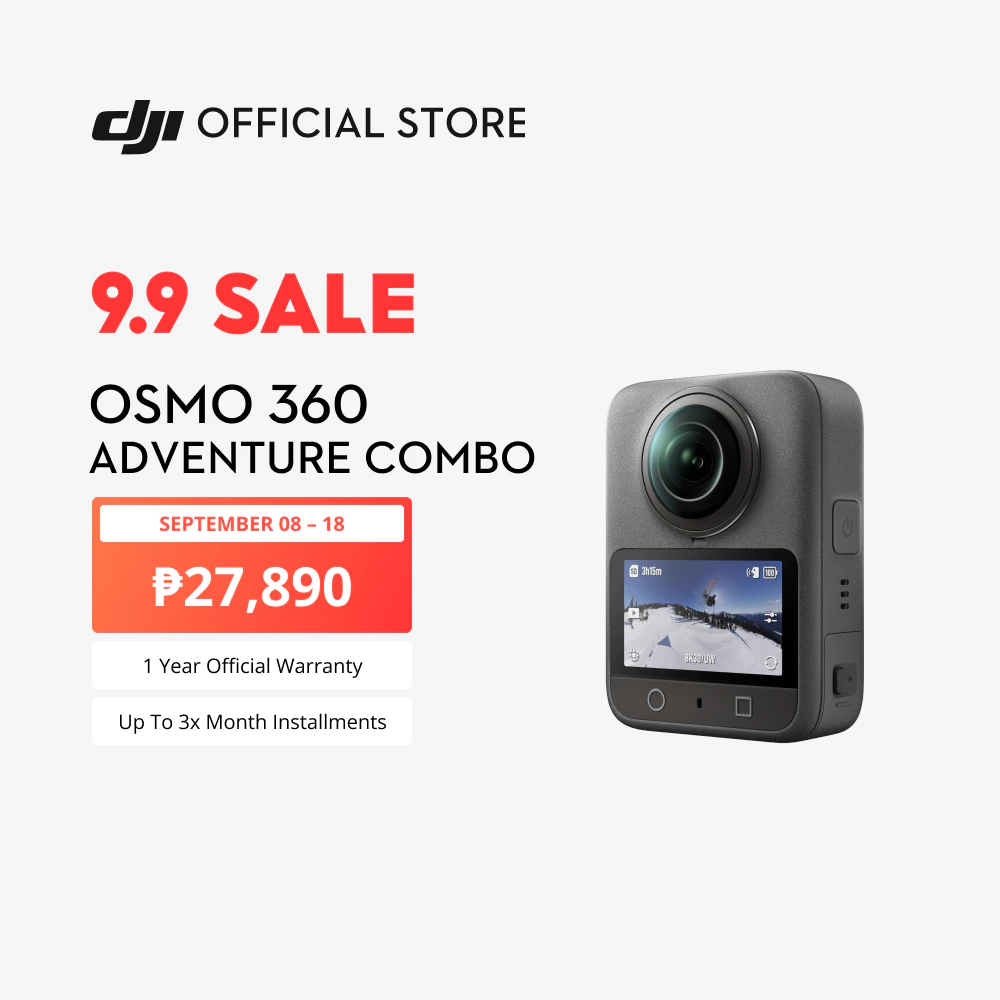
- Adventure Combo: ₱30,990
Osmo 360 II
- Standard Combo: ₱32,490
- Adventure Combo: ₱39,490
- Limitless Riding Combo: ₱34,490
Accessories
- Osmo 360 II Lens Replacement Kit (Single): ₱1,190
- Osmo 360 II Lens Replacement Kit (Dual): ₱1,890
- Osmo 360 II Battery Extension Rod: ₱5,590
- Osmo Multifunctional Battery Case 3: ₱3,299
Affiliate Links
- Osmo 360 Gen 1 on Shopee: https://s.shopee.ph/4fvuthJT7t
- Osmo 360 II on Shopee: https://s.shopee.ph/9fKaqqvsc1
The Bottom Line
The Osmo 360 II is a real upgrade. Not a gimmick, not a cash grab. It’s faster, smarter, and built tougher.
But the Gen 1 is still a 360 camera that works.
If you own one, you’re not sitting on a mistake. If you’re buying now, the II is worth 8,000 pesos if you shoot in challenging light, ride motorcycles, or create professional content. If you’re a casual traveler or 360-curious beginner, the Gen 1 is still the play.
The FOMO is real. The upgrade is justified. They’re not the same thing.