Stop scrolling. If you’re a vlogger, filmmaker, or travel creator in the Philippines right now, one of these three cameras belongs in your bag.
Choosing wrong costs you thousands.
The 360 action camera game just shifted. The Insta360 X6 launched August 12 at ₱45,390. It’s serious hardware.
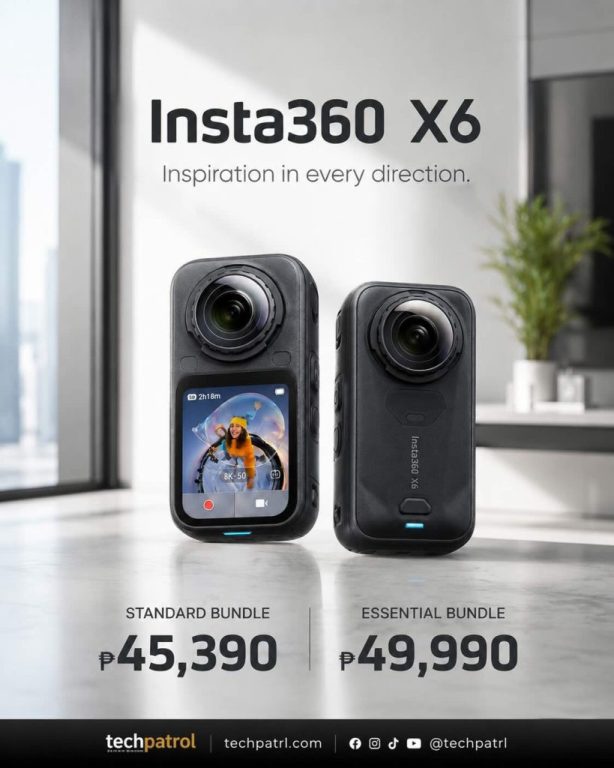
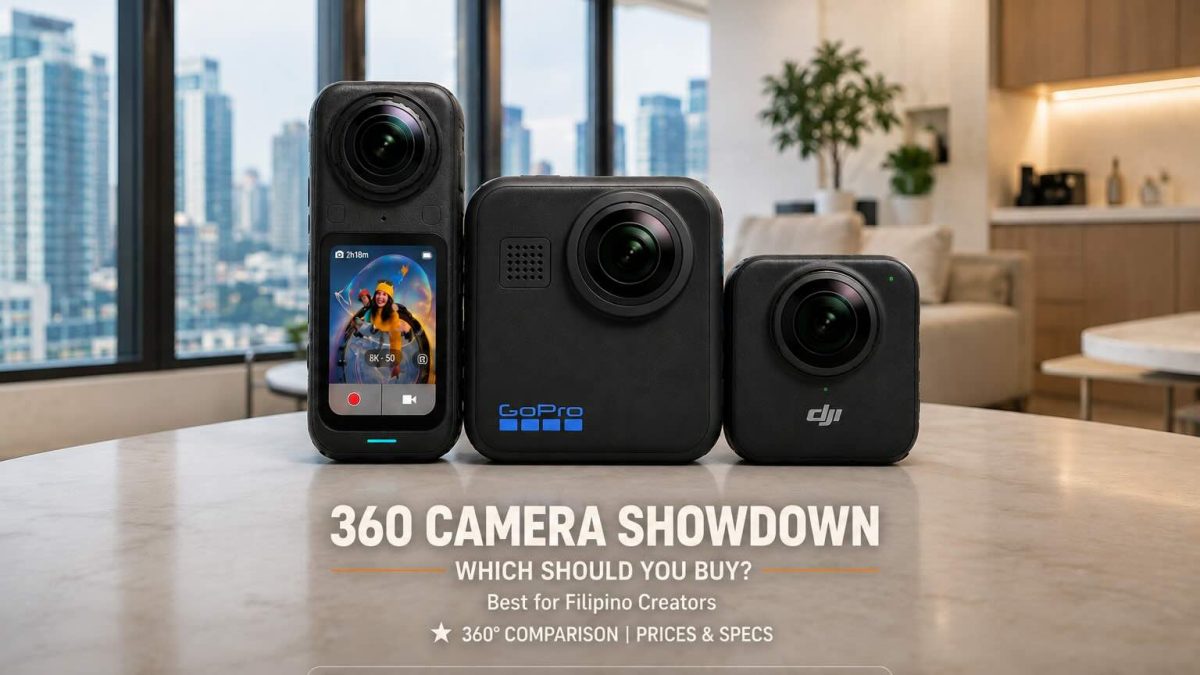
But before you buy, you need to know how it stacks up against the GoPro MAX 2 (₱22,990) and the DJI Osmo 360 (₱24,490).
These three aren’t the same camera at different prices. They’re built for different creators doing different work.
This isn’t a spec dump. This is what matters.
- What a 360 Camera Actually Does (And Why You Might Actually Need One)
- The Three Cameras: What They Are
- Spec Sheet: Insta360 X6
- Spec Sheet: GoPro MAX 2
- Spec Sheet: DJI Osmo 360
- The Real Comparison: Video Quality Where It Counts
- Sensor and Light
- Frame Rates and Formats
- Color Science and Professional Workflows
- Stabilization and Subject Tracking
- Battery Life and Runtime
- Build and Durability
- AI, Editing, and the Post-Workflow
- Insta360 X6: AI Director & PanoMind
- GoPro MAX 2: Quik App Reframing (With Caveats)
- DJI Osmo 360 (Gen I & II): DJI Mimo App
- Price vs. Reality: What You’re Actually Paying For
- The Real Picture
- Who Should Buy What
- Get the Insta360 X6 if…
- Get the GoPro MAX 2 if…
- Get the DJI Osmo 360 II if…
- The Honest Verdict for Filipino Creators
- Final Thought
- Where to Buy (PH)
What a 360 Camera Actually Does (And Why You Might Actually Need One)
Most action cameras don’t shoot 360. That matters.
360 changes your entire workflow.
With a standard action camera, you frame, aim, and lock. Miss the moment three feet to the left? Tough luck. You reframe in edit, but you’re cropping into lower resolution.
With a 360 camera, everything changes.
You capture everything around you at once. No aiming. No second-guessing angles.
Here’s the magic: you reframe after you’ve stopped recording.
You can pan across the scene. Lock onto a subject like a gimbal. Even pull flat 4K video from the spherical 360 capture.
One camera. Three shooting modes. One shot.
For Filipino creators doing vlogging, motorcycle content, travel docs, or sports POV, that’s not a gimmick.
That’s a workload multiplier.
The Three Cameras: What They Are
Insta360 X6 — The flagship. Just arrived. Bigger sensors, smarter AI, premium price. ₱45,390.
GoPro MAX 2 — The action-cam alternative. Stronger build, replaceable lenses, familiar GoPro ecosystem. ₱22,990.
DJI Osmo 360 — The value play. Smaller price tag, strong specs, tight DJI ecosystem. ₱24,490.
They’re all shooting 8K 360 video. The differences are where it matters: sensor quality, battery life, low-light performance, AI tools, and ecosystem lock-in.
Spec Sheet: Insta360 X6
Insta360 X6
Dual custom Sony sensors. 10-bit I-Log. AI that edits for you. Everything creators need in one pocket-sized package.
Spec Sheet: GoPro MAX 2
GoPro MAX 2
Replaceable lenses. True 8K video. Built for action. The 360 camera that doesn’t compromise on durability.
Spec Sheet: DJI Osmo 360
DJI Osmo 360
8K at 50fps for less. Tight DJI integration. The smart pick if you already own DJI gear.
The Real Comparison: Video Quality Where It Counts
This is where the ₱20k price spread actually matters.
Sensor and Light
The Insta360 X6 uses custom dual Sony 1/1.1-inch square sensors.
Custom. Not off-the-shelf. Insta360 commissioned these specifically for 360 imaging.
They’re optimized for the spherical format. Generic action-cam sensors aren’t.
What you get:
- 33% more sensor area than the X5
- 4x the light intake per frame (Insta360’s claim)
In tests, the X6 shows noticeably cleaner footage in dim scenarios.
Indoor events. Sunset shoots. Night vlogging.
The GoPro MAX 2 uses a smaller 1/2.3-inch sensor.
The DJI Osmo 360 matches the X6’s 1/1.1-inch size but uses DJI’s own configuration.
In head-to-head low-light tests, the X6 holds color better. Shows less noise.
For Filipino creators shooting at night markets, clubs, or evening travel videos?
This isn’t academic. It’s the difference between usable and unusable footage.
Frame Rates and Formats
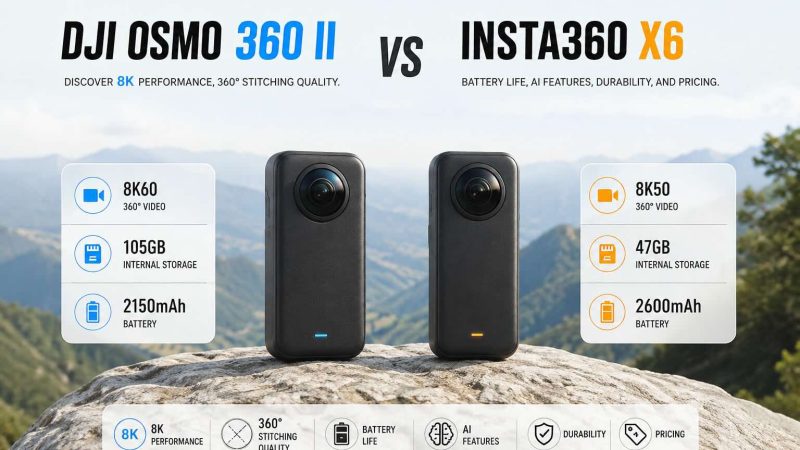
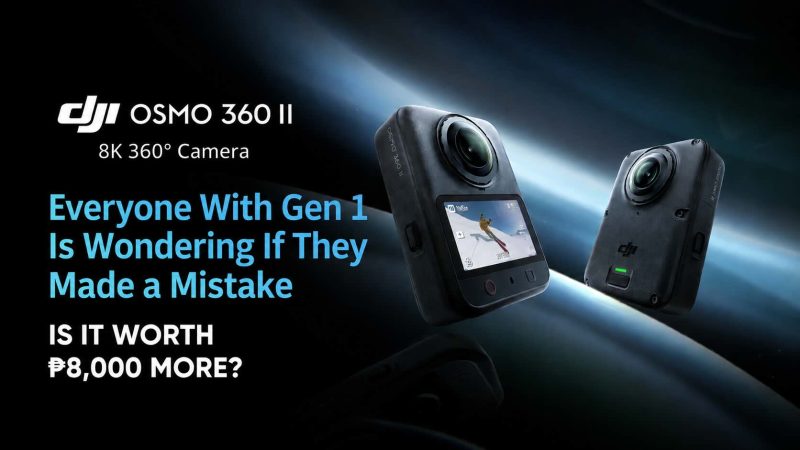
Critical Update: The original DJI Osmo 360 (Gen 1, still in stock) maxes out at 8K/30fps. The newly launched DJI Osmo 360 II (August 13, 2026) is the one that delivers 8K/60fps. If you’re shopping now, clarify which generation you’re buying—they’re not the same camera.
Frame rate specs:
- Insta360 X6 — 8K at 50fps. Also 6K at 60fps, 5.7K at 60fps, 4K at 120fps.
- GoPro MAX 2 — 8K at 30fps. Also 5.6K at 60fps, 4K at 60fps. Slow-mo capped at 4K at 100fps.
- DJI Osmo 360 Gen I — 8K at 30fps (limited). 6K at 60fps, 4K at 120fps.
- DJI Osmo 360 II (NEW) — 8K at 60fps (matching X6’s fluidity). 6K at 60fps, 4K at 120fps. Plus replaceable lenses.
Here’s where you feel the difference: at 8K30, motion looks softer than 8K50 or 8K60. If you’re shooting motorcycles, action sports, or fast-moving travel scenes, the X6 and Osmo 360 II give you noticeably smoother footage. The original Osmo 360 (Gen I) limps along at 8K30, matching the GoPro MAX 2. The GoPro compensates with an excellent 5.6K60, which is actually plenty sharp and steadier-feeling due to higher frame rate.
The slow-motion game favors the X6 and Osmo 360 II—both can hit 4K at 120fps. GoPro caps there too, but the X6 can push 8K at 100fps for slow-motion bullet-time effects (though expect cropping).
Recommendation: If you’re considering DJI, wait for the Osmo 360 II. The Gen I’s 8K30 is no longer competitive at this price point.
Color Science and Professional Workflows
This is where the X6 pulls away.
The Insta360 X6 ships with native 10-bit I-Log recording across all modes.
You’re capturing flat, log-encoded footage ready for color grading. Think of it like shooting RAW, but for video.
You get:
- More color information
- More shadow detail
- More flexibility in post-production
Vloggers who grade footage know this: shooting flat log is always worth it.
The DJI Osmo 360 does not shoot I-Log natively. It shoots standard SDR video only. You can grade it. But you’re starting from a compressed color space.
The GoPro MAX 2 also lacks native log. GoPro introduced GP-Log on certain models. But not on the MAX 2. And even if they do update it, it won’t match Insta360’s 10-bit workflow.
If you grade everything, the X6’s 10-bit I-Log is huge. YouTube videos. TikTok content. Instagram Reels with intentional color grading.
Your footage looks more cinematic with less effort.
Casual vloggers won’t notice. Film creators absolutely will.
Stabilization and Subject Tracking
All three use digital stabilization (“horizon lock” in GoPro speak, “RockSteady” in DJI, “FlowState” in Insta360). Digital stabilization is good enough now that the gap is tiny.
Where they diverge is AI subject tracking:
- Insta360 X6 — “InstaFrame 2.0” can lock onto a subject and reframe around them in real-time. It’s designed to mimic gimbal framing. This is strong for vlogging, where you’re pointing the camera at yourself or tracking a moving subject. The AI scans the entire 360 sphere, not just a 2D frame, so it’s more flexible.
- GoPro MAX 2 — Has object tracking in the Quik app (post-edit), not in-camera. You reframe after recording.
- DJI Osmo 360 — No mention of native subject tracking. You’re reframing in post via DJI’s app.
For Filipino vloggers doing self-shot content or following friends through night markets and beaches, the X6’s real-time framing is a genuinely useful feature. It’s not essential, but it’s nice.
Battery Life and Runtime
This matters if you’re shooting all day.
Insta360 X6:
- 2,600 mAh battery
- Up to 140 minutes at 8K30fps
- Charges to 80% in 22 minutes
GoPro MAX 2:
- 1,960 mAh battery
- ~90 minutes typical use
- Slower charging
DJI Osmo 360:
- ~90 minutes typical use
- Similar to GoPro
The difference? X6 lasts significantly longer.
For travel creators or event filmmakers, this means fewer charging cycles. Fewer spare batteries needed.
Shooting motorcycle tours across Luzon? That extra runtime is genuine value.
Build and Durability
Insta360 X6:
- IP68 rated
- Waterproof to 20m without housing
- Up to 60m with Invisible Dive Case ($179.99 / ₱10k+)
- Compact at 196g
GoPro MAX 2:
- IP67 rated
- Waterproof to 5m
- Lighter overall
- Replaceable lenses (huge advantage)
- Better action-cam ergonomics
DJI Osmo 360:
- Waterproof
- Depth rating unclear
- Fixed lenses (weakness vs GoPro)
Shoot a lot in water? (diving, snorkeling, beach/river content) → X6 with dive case is the pick.
Crash gear frequently? (want to swap a scratched lens without buying a new camera) → GoPro’s replaceable glass is insurance.
Durability? DJI is solid but falls between the other two.
AI, Editing, and the Post-Workflow
This is increasingly the differentiator, not sensors.
Insta360 X6: AI Director & PanoMind
The X6 introduced “PanoMind,” a triple-AI-chip system designed to analyze entire 360 spheres in real-time. It powers two workflows:
- AI Director — Plug the camera in to charge, and it analyzes your day’s footage in the background. By morning, the app has generated highlight reels with cuts, transitions, music, and dynamic pans. You can refine, but it does the heavy lifting.
- Auto Edit 2.0 — Similar but allows manual keyframing on top of AI suggestions.
For travel vloggers who shoot 4+ hours a day and hate editing, this saves real time. The integration is seamless—camera to cloud to your phone, no painful hand-offs.
GoPro MAX 2: Quik App Reframing (With Caveats)
GoPro’s strength is the Quik app, which has gotten quite good at object tracking and reframing. It’s not automatic in the way Insta360’s AI Director is—you’re still guiding it—but it’s fast. You shoot, upload, and reframe on your phone in minutes.
But here’s the reality: Professional reviewers (notably DC Rainmaker) and widespread user feedback flag significant workflow frustrations with GoPro’s mobile and cloud sync compared to Insta360’s seamless app integration or DJI’s Mimo ecosystem. File management can be clunky, uploads are slower, and the reframing interface isn’t as intuitive. For casual creators, it works. For professionals managing large projects, it’s a friction point.
Also: Make sure your phone/computer can handle high-res file management. GoPro’s 8K files are chunky, and the software doesn’t always play nice with storage constraints.
DJI Osmo 360 (Gen I & II): DJI Mimo App
DJI’s ecosystem is solid and well-integrated with other DJI gear (drones, gimbals). Reframing via Mimo is competent and straightforward. The Gen II adds replaceable lenses, which is a huge durability win.
However, Mimo lacks the “magic” factor of Insta360’s AI Director—it’s a manual reframing tool, not an auto-editing suite. You’re doing more work post-shoot than with the X6.
Winner for lazy creators: Insta360 X6 (AI does the work, no app friction). Winner for action sports (rugged hardware): GoPro MAX 2 (replaceable lenses, reliable build). Winner for DJI ecosystem users: Osmo 360 II (native integration + new replaceable lenses). Winner for workflow smoothness: Insta360 X6 (no contest).
Price vs. Reality: What You’re Actually Paying For
| Insta360 X6 | GoPro MAX 2 | DJI Osmo 360 Gen I | DJI Osmo 360 II | |
|---|---|---|---|---|
| Price (PH) | ₱45,390 | ₱22,990 | ₱24,490 | ~₱32,000* |
| Video Ceiling | 8K @ 50fps | 8K @ 30fps | 8K @ 30fps | 8K @ 60fps |
| Key Feature | 10-bit I-Log + AI Director | Replaceable lenses | Budget 360 cam | Replaceable lenses + 8K60 |
| Battery | 140 min | ~90 min | ~90 min | ~90 min |
| Strength | Color grading ready, auto-editing | Action durability | DJI ecosystem | Best of both worlds |
*Osmo 360 II price estimated based on regional launches; confirmed locally.
The Real Picture
The GoPro MAX 2 is half the price of the X6. For casual vloggers and casual travel creators, the MAX 2’s video quality is perfectly adequate. The replaceable lenses are a legitimate long-term value factor—one lens replacement ($50–100) vs. buying a new camera. But be prepared for slower, more cumbersome editing workflows compared to Insta360 or DJI.
The DJI Osmo 360 Gen I at ₱24,490 is tempting, but it’s the weakest choice now. At 8K/30fps, it matches the GoPro’s frame rate ceiling and costs more. If you’re buying DJI, get the Gen II. The Osmo 360 II (launched August 13) adds replaceable lenses AND 8K/60fps, making it a genuine X6 competitor.
The Insta360 X6 costs 2x the competition because:
- Custom optimized sensors (not generic action-cam components).
- 10-bit I-Log from day one (game-changer for color grading).
- 140-minute battery life (vs. 90 minutes—adds up on all-day shoots).
- AI Director auto-editing (saves hours of manual work weekly).
- Smoothest app ecosystem (no workflow friction).
- Latest generation (freshest algorithms, longest OS support).
Is it worth the premium? Depends on your workflow. If you shoot daily, grade footage, or hate editing, yes. If you shoot weekends and rely on simple cuts + music, the MAX 2 is probably enough.
Who Should Buy What
Get the Insta360 X6 if…
- You shoot 3+ hours of 360 content per week.
- You care about low-light quality (night markets, indoor events, sunset content).
- You grade your footage or want pro-level color tools.
- You want AI to handle rough cuts for you.
- You’re okay spending premium pricing for a generation-ahead camera.
- You shoot in water (with the dive case).
- You want the latest ecosystem and longest software support.
Buy here:
- Shopee: https://s.shopee.ph/3B6a2ISf5d
- Lazada: https://s.lazada.com.ph/s.ZhRJ2z
Get the GoPro MAX 2 if…
- You want the cheapest 360 camera without sacrificing quality.
- You’ve already invested in GoPro mounts and ecosystem.
- You crash gear occasionally and need replaceable lenses.
- You shoot mostly bright, well-lit scenes (outdoor adventure, daytime vlogging).
- You want a camera that “just works” without learning new workflows.
- You prefer Quik’s intuitive reframing over AI auto-edit.
- You don’t need log color grading.
Buy here: GoPro MAX 2 is available at most major Philippine retailers (Power Mac Center, Best Buy, SM Cyberzone).
Get the DJI Osmo 360 II if…
- You already own DJI drones or gimbals (ecosystem integration is real).
- You want 8K at 60fps with replaceable lenses for the first time.
- You don’t need 10-bit log or AI auto-editing (those stay X6-exclusive).
- You want the best action sports durability (replaceable lenses = crash insurance).
- You value DJI’s warranty and local service network.
Critical Note: The original DJI Osmo 360 (Gen I) is technically still available but outclassed. It maxes out at 8K/30fps and has fixed lenses. If you’re shopping, get the Osmo 360 II (launched August 13, 2026). Don’t let old stock mislead you into a Gen I purchase—the II is the real competitor to the X6.
Skip the Osmo 360 Gen I entirely. The extra cost over GoPro MAX 2 isn’t justified when the MAX 2 also does 8K/30fps. Wait for the II or go X6.
The Honest Verdict for Filipino Creators
If you could buy only one: The Insta360 X6 is the most well-rounded and future-proof, but it’s expensive. If budget is your limit, the GoPro MAX 2 won’t disappoint—it’s genuinely good and half the price. Just know you’ll be managing larger files and dealing with slower sync times.
If you’re on a tight budget: Don’t get the DJI Osmo 360 Gen I. It’s ₱24,490 for 8K/30fps—why not spend ₱2,500 more on the Osmo 360 II and get 8K/60fps + replaceable lenses? If you absolutely can’t stretch the budget, the GoPro MAX 2 at ₱22,990 is a better value at that price.
If you’re already in the DJI ecosystem: Get the Osmo 360 II (just launched Aug 13). It integrates with your drones and gimbals, and the replaceable lenses are a game-changer for action creators who crash gear. 8K/60fps makes it competitive with the X6 for motion smoothness.
If you’re an action sports creator: GoPro MAX 2 — the replaceable lenses are real durability insurance. Crack a front lens on your X6, and you’re sending the whole camera for repair. Crack a MAX 2 lens, and you swap it in 30 seconds for $50–100. For motocross, mountain biking, or any high-impact sport, this matters.
If you shoot pro cinematic content: X6 only. The 10-bit I-Log is non-negotiable for color grading. AI Director saves you 3–5 hours per shoot on rough cuts. These aren’t luxuries—they’re production-time multipliers that pay for themselves in the first month of professional work.
If you prioritize smooth editing workflow: X6. Insta360’s app ecosystem is the most intuitive of the three. GoPro’s Quik app has well-documented friction with file sync and mobile editing. DJI Mimo is solid but manual. If editing speed matters, X6’s AI Director is unbeatable.
Final Thought
As of August 2026, there are really four cameras in this space now, not three:
- Insta360 X6 — “We built this specifically for spherical imaging with cinema tools baked in. 10-bit I-Log, AI editing, 8K/50fps. No compromises.”
- GoPro MAX 2 — “We made an action camera that also shoots 360. Rugged, replaceable lenses, reliable hardware. But expect to put in editing work.”
- DJI Osmo 360 Gen I — “Don’t buy this anymore. Wait for the Gen II.”
- DJI Osmo 360 II (NEW) — “We listened. 8K/60fps, replaceable lenses, tight ecosystem integration. Now we compete with the X6 on motion smoothness.”
Your Filipino audience doesn’t know (or care) which camera you used. They care that your travel vlog shows the whole beach, your motorcycle POV is steady without frame drops, your night market content doesn’t look like you filmed it on a potato, and your reframing workflow doesn’t take 6 hours per day.
Pick based on your reality:
- Casual vlogging + action sports → GoPro MAX 2 (save ₱22,400)
- Professional color grading + daily editing → Insta360 X6 (invest in the tools)
- DJI ecosystem user → Osmo 360 II (best balance of price and performance now)
- Budget-conscious but want 8K/60fps → Osmo 360 II over Gen I (a few thousand more, worth it)
Choose wisely. And if you see Osmo 360 Gen I on a shelf at a discount, ask the seller if the Gen II is in stock first.
Where to Buy (PH)
Insta360 X6
- Shopee: https://s.shopee.ph/3B6a2ISf5d
- Lazada: https://s.lazada.com.ph/s.ZhRJ2z
- Henry’s Camera (official distributor)
GoPro MAX 2
- Power Mac Center (nationwide)
- Best Buy PH
- Altitude Philippines
- Various electronics retailers
DJI Osmo 360
- Lazada: https://s.lazada.com.ph/s.ZhRJCy
- Shopee: https://s.shopee.ph/5fnwKpD1qX
- Official DJI stores – https://s.shopee.ph/5fnwKpD1qX