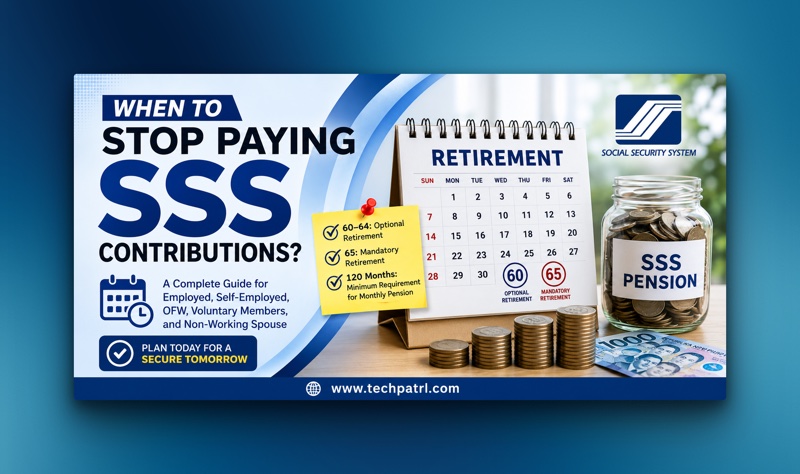
The question haunts every Filipino worker as they approach retirement: When should I actually claim my SSS benefits?
It sounds simple. You hit 60, you retire, you start drawing your pension. But the reality is far more nuanced—and the difference between claiming at 60 versus 65 versus 70 can mean tens of thousands of pesos over your lifetime.
This guide walks you through the strategic decision-making behind SSS benefit claiming, the hidden tradeoffs, and the real numbers you need to make the right call for your situation. Whether you’re a freelancer juggling self-employment contributions or a traditional employee planning your exit, the framework here will help you navigate this decision with clarity.
- Know Your Exact Numbers First
- The Problem: Why Claiming “When You Turn 60” Isn’t Always the Right Move
- The SSS Claiming Framework: Age, Contribution History, and Your Three Paths
- Path 1: Early Claim at Age 60
- Path 2: Normal Claim at Age 65
- Path 3: Delayed Claim at Age 70+
- The Strategic Variables: What Actually Matters in Your Decision
- 1. Your Contribution History (and Your “Average Salary Credit”)
- 2. Your Current Income Situation (Can You Afford to Wait?)
- 3. Your Health and Family Longevity
- 4. Your Planned Post-Retirement Lifestyle
- 5. Inflation and Cost-of-Living in Your Area
- The Math: Three Real Scenarios for Philippine Freelancers
- Scenario A: Claim at 60 (Early)
- Scenario B: Claim at 65 (Normal)
- Scenario C: Claim at 70 (Delayed)
- Special Considerations for Freelancers and Self-Employed Workers
- You Can Keep Earning While Collecting Benefits
- Plan Around Your Business Cycle
- Document Your Contributions Carefully
- The Decision Framework: A Step-by-Step Approach
- The Psychology of SSS Claiming (And Why Retirees Often Get It Wrong)
- Action Steps: What to Do Next
- Bottom Line
- Official Sources & References
- Related TechPatrol Guides on SSS
- Get Your Exact Numbers Now
- Quick Reference: SSS Claiming Ages at a Glance
- FAQ: Common SSS Claiming Questions
Know Your Exact Numbers First
Before reading this guide, use the Tech Patrol SSS Pension Calculator to get your baseline monthly pension amount. Your actual figures make this decision crystal clear.
👉 Use Tech Patrol SSS Pension Calculator
The Problem: Why Claiming “When You Turn 60” Isn’t Always the Right Move
Here’s what most Filipinos assume: You contribute to SSS for 30+ years. At age 60, you’re eligible. So you claim immediately.
Sounds logical. It’s also incomplete.
The SSS benefit system is designed with longevity in mind. The longer you wait to claim, the higher your monthly pension becomes. This isn’t a minor bump—depending on your contribution history, delaying your claim by five years can increase your monthly benefit by 20-30% or more.
For a freelancer or small business owner earning ₱100,000 monthly, the difference between claiming at 60 and claiming at 65 could represent an additional ₱5,000-₱8,000 per month in perpetuity. Over 20 years of retirement, that’s an extra ₱1.2 million to ₱1.9 million in lifetime benefits.
But here’s the catch: You can’t claim those extra benefits if you’re not alive to collect them. That’s why the decision isn’t just mathematical—it’s deeply personal.
The SSS Claiming Framework: Age, Contribution History, and Your Three Paths
The SSS system gives you flexibility. You can claim benefits at three different ages, each with its own benefit calculation:
Path 1: Early Claim at Age 60
Who it’s for: Workers who need income immediately, have health concerns, or won’t reach their break-even point if they delay.
How it works: You can claim your monthly retirement pension as early as age 60, provided you have at least 120 months (10 years) of contributions.
The catch: Your monthly benefit is reduced. The SSS applies a 0.5% reduction for each month you claim before age 65. This means claiming at 60 (60 months early) results in a 30% permanent reduction to your monthly pension.
Example:
- If your normal monthly pension at 65 would be ₱15,000, claiming at 60 would give you ₱10,500 per month for life.
- You gain 60 months of income (₱10,500 × 60 = ₱630,000) immediately.
- But you lose ₱4,500 per month for every month thereafter.
- Break-even happens at around age 79—if you live past that, you’ve made a net loss on claiming early.
Best for: Self-employed workers or freelancers who have irregular income and want to formalize their retirement while they’re still earning, or those with health concerns that suggest shorter life expectancy.
Path 2: Normal Claim at Age 65
Who it’s for: The majority of workers. This is the “designed” claiming age.
How it works: You claim your full monthly retirement pension at age 65, with no reduction applied. This is your baseline benefit calculation.
Why it matters: Age 65 is the actuarial midpoint. SSS calculations assume you’ll live another 15-20 years, which means the benefit amount is optimized for longevity without penalizing early claiming.
Example:
- Your monthly pension at 65: ₱15,000
- You claim starting at age 65 and receive ₱15,000/month from then on.
- If you live to 85, you’ll have received ₱3.6 million in benefits over 20 years.
Best for: Workers with stable health expectations, a 30+ year contribution history, and the flexibility to keep working or living off other income until 65.
Path 3: Delayed Claim at Age 70+
Who it’s for: Workers who are still earning, have strong health and longevity in their family, or want to maximize their monthly pension.
How it works: For every year you delay claiming beyond age 65, the SSS adds a 12% bonus to your monthly benefit. Delay until age 70 (5 years) and you get a 60% boost. Some workers wait until 72 for an 84% increase.
Example:
- Your baseline pension at 65: ₱15,000
- If you delay to age 70, your monthly benefit becomes: ₱15,000 × 1.60 = ₱24,000/month
- You’ve foregone 60 months of ₱15,000 (₱900,000), but now you’re collecting ₱24,000 instead.
- Break-even occurs at age 79-80. After that, every month you’re ahead.
Best for: Self-employed professionals, business owners, or freelancers who can afford to keep working and generating income, combined with good family longevity history and strong health.
The Strategic Variables: What Actually Matters in Your Decision
The “right” claiming age isn’t universal. Here are the real factors that should shape your choice:
1. Your Contribution History (and Your “Average Salary Credit”)
The higher your contributions over your working years, the higher your baseline pension. This matters because the percentage reductions and bonuses apply to your number, not a fixed amount.
A freelancer who averaged ₱100,000 in monthly contributions will see a much larger dollar difference between claiming at 60 versus 70 than someone who averaged ₱20,000.
Action: Calculate your exact Average Salary Credit (ASC) using the SSS Pension Calculator. This is the foundation of everything else.
2. Your Current Income Situation (Can You Afford to Wait?)
A salaried employee age 65 with pension income, rental properties, and savings can easily wait until 70. A self-employed freelancer with no other income streams might need to claim at 60, even with the 30% penalty.
The reality: Claiming at 60 with a penalty is still better than having no retirement income at all.
3. Your Health and Family Longevity
This is the uncomfortable factor most guides skip. But it’s crucial.
If you have a family history of longevity (parents who lived into their 80s and 90s), delaying your claim becomes mathematically attractive. If you have health concerns or a family history of earlier mortality, claiming earlier is more rational.
You’re not being morbid—you’re being realistic about your own life expectancy.
Action: Be honest about your health outlook and family history. This isn’t just medical—it’s financial.
4. Your Planned Post-Retirement Lifestyle
Do you plan to:
- Retire completely and travel?
- Continue freelancing or consulting part-time?
- Start a small business?
- Live quietly and keep expenses low?
Someone planning to stay active and travel internationally might want the higher monthly benefit (delayed claiming). Someone planning to live quietly on a modest budget might claim earlier and invest the difference.
5. Inflation and Cost-of-Living in Your Area
SSS benefits are adjusted annually for inflation, but the adjustments often lag actual cost-of-living increases in the Philippines. A larger baseline monthly benefit (from delayed claiming) provides more cushion against future inflation.
If you’re living in Metro Manila with high expenses, a larger monthly pension becomes more valuable. If you’re in a provincial area with lower cost of living, the difference matters less.
The Math: Three Real Scenarios for Philippine Freelancers
Let’s work through three realistic scenarios using the same person at different claiming ages.
Baseline assumptions:
- 30 years of contributions (solid freelancer history)
- Average Salary Credit: ₱45,000/month
- Normal (65-year-old) monthly benefit: ₱18,000
- Life expectancy: Age 85 (realistic for a healthy Filipino)
Scenario A: Claim at 60 (Early)
- Monthly benefit: ₱18,000 × 0.70 = ₱12,600
- Months of payments (60-85): 300 months
- Total lifetime benefit: ₱3,780,000
Scenario B: Claim at 65 (Normal)
- Monthly benefit: ₱18,000
- Months of payments (65-85): 240 months
- Total lifetime benefit: ₱4,320,000
Scenario C: Claim at 70 (Delayed)
- Monthly benefit: ₱18,000 × 1.60 = ₱28,800
- Months of payments (70-85): 180 months
- Total lifetime benefit: ₱5,184,000
The difference: Claiming at 70 versus 60 yields an extra ₱1,404,000 over your lifetime—even accounting for the five years you didn’t receive any pension income.
But notice: If you’re only expected to live to age 78, claiming at 60 becomes the better option. The break-even age for 60 vs. 70 is around age 79.
Ready to see YOUR exact numbers instead of guessing?
👉 Use the Tech Patrol SSS Pension Calculator to plug in your actual salary credit and contribution years. Your real scenarios will be far more accurate than these examples.
Special Considerations for Freelancers and Self-Employed Workers
As a self-employed contributor, you have flexibility that salaried employees don’t:
You Can Keep Earning While Collecting Benefits
Salaried employees face “retirement”—they leave employment and SSS stops counting contributions. Freelancers can keep contributing to SSS while claiming benefits.
This creates an interesting strategy:
- Claim at 60 for income security.
- Continue freelancing and contributing to SSS.
- At 65, you can request a recalculation of your benefits based on your updated contribution history.
- This effectively “resets” your benefit calculation, potentially recouping some of the early-claim penalty.
Plan Around Your Business Cycle
If you run a business with seasonal fluctuations, consider your claiming age in relation to your business’s typical cash flow. Claiming when you anticipate lower business income smooths out your financial pressure.
Document Your Contributions Carefully
Self-employed contributors bear the burden of maintaining their contribution records. Errors or gaps can reduce your benefit calculation. Verify your records with SSS at least one year before you plan to claim.
The Decision Framework: A Step-by-Step Approach
Here’s how to make this decision systematically:
Step 1: Calculate Your Exact SSS Pension Amount
Use the SSS Pension Calculator to determine your Average Salary Credit and your baseline monthly benefit at age 65. This is your anchor number—everything else derives from this.
Step 2: Model the Three Scenarios
Calculate what you’d receive at ages 60, 65, and 70 using the reduction/bonus percentages above. See the actual peso differences.
Step 3: Determine Your Break-Even Age
Using your three scenarios, calculate at what age claiming later becomes beneficial. For most Filipinos with 30+ year contribution histories, this is around age 78-80.
Step 4: Assess Your Life Expectancy Honestly
- Are you expecting to live past your break-even age?
- Do you have family longevity on your side?
- What’s your current health status?
This doesn’t require morbidity—just realism.
Step 5: Evaluate Your Financial Situation at Each Age
- At 60: What’s your income situation? Can you afford not to claim?
- At 65: What’s changed? Do you have pension, rental income, business income?
- At 70: Are you still able and willing to work?
Step 6: Make Your Decision with a Time Horizon
You’re not committing to one path forever. If you claim at 60 and circumstances change dramatically (say, you inherit property income at 66), that’s okay. SSS benefits are your baseline—not your entire financial picture.
The Psychology of SSS Claiming (And Why Retirees Often Get It Wrong)
Here’s an uncomfortable truth: Most Filipino retirees claim at 60 not because it’s optimal, but because they’re anxious about missing out on benefits they’ve “earned.”
The feeling makes sense. You’ve contributed for 30+ years. You want to start collecting. Waiting feels like leaving money on the table.
But mathematically, for someone with good health and family longevity, waiting is leaving more money on the table—it’s just deferred.
The key is aligning the decision with your actual circumstances, not emotional reasoning.
Action Steps: What to Do Next
- Run your numbers through the Tech Patrol SSS Pension Calculator. Know your exact Average Salary Credit and baseline monthly benefit.
👉 Get Your Exact SSS Pension Figure
- Talk to your family about longevity. How long did your parents, grandparents, and aunts/uncles live? This informs your realistic life expectancy.
- Project your income five years out. If you’ll be working or have other income sources until 65+, delaying becomes more viable.
- Visit the nearest SSS office (or check online) to verify your contribution record. Errors can reduce your benefit by thousands.
- Make a decision, but not in stone. Choose your claiming age, but revisit it annually as your circumstances change.
Bottom Line
There is no universal “right” age to claim SSS benefits. But there is a right age for you.
For many Filipino freelancers and workers with strong contribution histories and reasonable health prospects, claiming at 65 offers the best balance: no penalty, a full baseline benefit, and reasonable life expectancy alignment.
For those who can afford it and come from long-lived families, delaying to 70 adds ₱1 million+ in lifetime benefits—a significant return on the five-year wait.
And for those facing immediate financial pressure or health concerns, claiming at 60 is rational, not wasteful—even with the 30% penalty.
The key is making an informed choice based on your numbers and circumstances, not assumptions or anxiety.
Use the Tech Patrol SSS Pension Calculator to know your exact figures, then decide with confidence.
Official Sources & References
This guide draws from:
- SSS Retirement Benefits Computation: Official SSS Retirement Pension Rules – Republic Act 11199 (Social Security Law of 2018)
- SSS Benefit Claiming Guidelines: Based on SSS Official Benefit Computation Methods
- RA 11199 & Social Security System Regulations: Philippine government social security framework
For official and updated information on SSS benefits, visit the Social Security System (SSS) Official Website.
Related TechPatrol Guides on SSS
Before finalizing your claiming decision, read these complementary guides:
- SSS Pension Calculator (2026): How Much Will You Get Monthly From SSS? — Calculate your exact monthly benefit right now.
- When to Stop Paying SSS Contributions in the Philippines (2026 Guide for All Member Types) — Understand if continuing contributions still benefits you.
- Should OFWs in the U.S. Still Pay SSS in 2026? — If you’re overseas, see if SSS contributions still make sense.
- SSS Voluntary Contribution Guide 2025: How to Keep Your Benefits Active — Maintain your SSS membership if you transition between jobs or become self-employed.
Get Your Exact Numbers Now
Guessing at your SSS benefit is costly. Don’t leave retirement planning to assumptions.
👉 Calculate Your Exact SSS Pension Using Tech Patrol’s Calculator
Once you have your baseline number, return to this guide and work through the three claiming scenarios. Your decision will be crystal clear.
Quick Reference: SSS Claiming Ages at a Glance
| Claiming Age | Monthly Benefit | Reduction/Bonus | Best For |
|---|---|---|---|
| 60 | Reduced | -30% | Immediate income needs, health concerns |
| 65 | Full benefit | None | Stable health, good work history, flexibility |
| 70 | Increased | +60% | Still working, family longevity, high earnings history |
FAQ: Common SSS Claiming Questions
Q: Can I change my claiming age after I’ve started receiving benefits? A: No, your claiming age is fixed once you start receiving benefits. This is why the decision matters.
Q: What if I claim early and then continue working? Does that increase my benefit later? A: Your monthly benefit remains fixed at whatever you were receiving at the time of claiming. Continued work contributions don’t increase an active pension (though you continue to contribute).
Q: How often do SSS benefits increase? A: The SSS adjusts benefits annually based on inflation. The exact percentage varies year to year, but recent adjustments have been in the 3-4% range.
Q: What happens if I pass away before I break even on my claiming age? A: Your beneficiaries receive a lump-sum settlement and continue receiving your monthly benefit (if applicable). The “break even” concept matters for your lifetime benefit, not their financial outcome.
Q: Can OFWs claim SSS benefits differently? A: OFWs with SSS coverage follow the same claiming rules as domestic workers. The decision framework is identical.