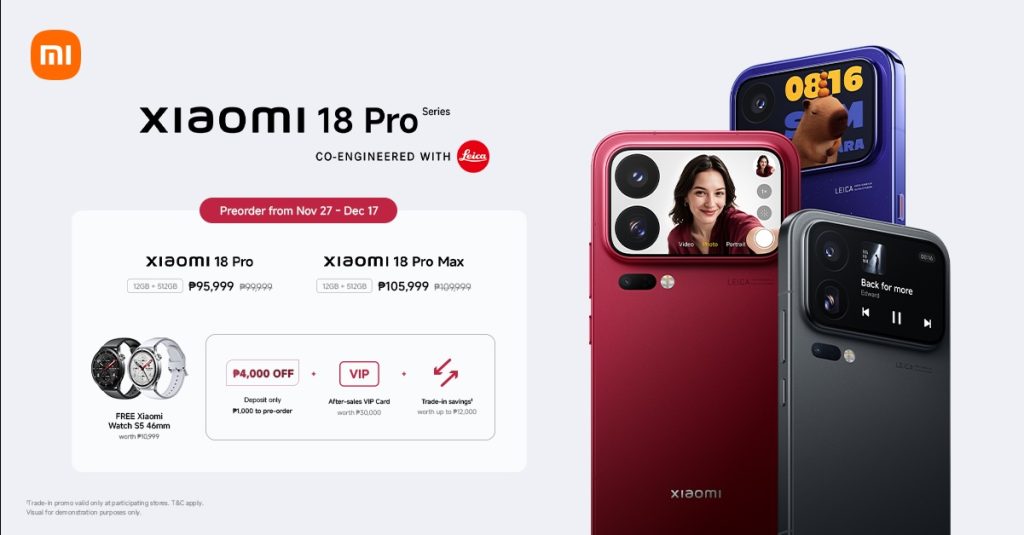
The country’s second-biggest phone brand has set the Xiaomi 18 Pro Philippines price at ₱95,999, with the bigger Pro Max at ₱105,999, which puts it above the ₱99,999 Xiaomi 17 Ultra that Xiaomi sold here in March.
Key Takeaways
- Xiaomi Philippines opened pre-orders for the Xiaomi 18 Pro (₱95,999) and 18 Pro Max (₱105,999), both in 12GB+512GB, from November 27 to December 17, 2026.
- The Pro Max costs ₱6,000 more than the Xiaomi 17 Ultra’s ₱99,999 SRP from March 2026.
- Xiaomi held 22% of Philippine smartphone shipments in Q2 2026, second only to Transsion, according to Omdia.
- Both phones carry a rear AMOLED screen, two 200MP Leica cameras, and Qualcomm’s Snapdragon 8 Elite Gen 6 chips.
Xiaomi Philippines launched the Xiaomi 18 Pro series on November 27, 2026, two months after the phones went on sale in China.
The lineup has two models. The 6.4-inch Xiaomi 18 Pro runs on the Snapdragon 8 Elite Gen 6, while the 6.9-inch 18 Pro Max gets the Snapdragon 8 Elite Extreme Gen 6, which Qualcomm calls its most powerful mobile chip so far.
Both come in Velvet Red, Black, White, and Cosmic Blue. Only the 12GB+512GB versions have local prices. Xiaomi's spec sheet also lists 12GB+256GB and 16GB+1TB versions, but the company has not priced them for the Philippines.
Buyers who put down a ₱1,000 deposit before December 17 get a ₱4,000 discount, a free Xiaomi Watch S5 46mm that Xiaomi values at ₱10,999, and an after-sales VIP Card it says is worth up to ₱30,000. Participating stores add up to ₱12,000 in trade-in savings.
Why the Xiaomi 18 Pro Philippines price matters
Two years ago, Xiaomi's top phone here was cheap by comparison. The Xiaomi 15 launched locally in March 2025 at ₱49,999 for the 12GB+512GB model.
This March, Xiaomi brought in its first official Ultra in years, the Xiaomi 17 Ultra, at ₱99,999. A Shopee pre-order deal cut that to ₱84,999.
The 18 Pro Max now clears that mark by ₱6,000, and it is not even branded as an Ultra.
It is also the first time Xiaomi has sold its back-screen Pro line here. The Xiaomi 17 Pro and 17 Pro Max, which introduced the rear display, stayed exclusive to China when the 17 series went global.
Memory costs are pushing every flagship up
Xiaomi is not raising prices alone. Counterpoint Research reported in September that new phone launches in 2026 cost about 25% more than the models they replaced, as makers pass on higher prices for DRAM, the memory chips that phones and AI data centers both need.
The same tracker found existing phones rose about 15% on average this year, with price-sensitive markets seeing 16% to 21% increases.
The jump shows in China too. The Xiaomi 18 Pro starts at 5,999 yuan there, up from 4,999 yuan for the 17 Pro a year earlier.
Xiaomi's position here makes the bet bigger. Omdia ranked it second in the Philippines in Q2 2026 with a 22% share, behind Transsion's 33% and ahead of Samsung's 16%. Most of that volume comes from budget Redmi phones, not ₱100,000 flagships.
Where to buy the Xiaomi 18 Pro series: Shopee · Lazada
What the Xiaomi 18 Pro's back screen does
The rear panel measures 2.7 inches on the Pro and 2.9 inches on the Pro Max. Xiaomi says it uses the same M11 AMOLED panel as the front screen, rated at up to 4,000 nits.
Its main job is as a rear viewfinder. You can frame selfies and vlogs with the 200MP main camera instead of the 50MP front one, and Xiaomi says the camera jumps to ultra-wide when it detects more than three faces.
It also shows ride-hailing, food delivery, and map alerts, and it can hold a pinned boarding pass or QR code. An AI Interpreter mode shows each speaker's language on their side of the phone, in 29 languages.
The cameras pair a 1/1.28-inch 200MP main sensor with a 200MP periscope telephoto covering 75mm to 150mm. The front screen adds a Privacy Display mode that dims what people beside you can see, a feature Xiaomi built into the panel hardware.
The Pro Max packs a 7,050mAh battery with 100W wired charging. The Pro gets 6,000mAh and 90W.
The Leica partnership and the China head start
The 18 Pro series marks five years of Xiaomi's camera tie-up with Leica. Xiaomi skipped the "16" name last year to line up its numbering with Apple's iPhone 17.
Xiaomi president Lu Weibing reportedly said the 17 Pro Max broke the company's first-day sales records in China, which explains why the rear screen came back for a second generation.
What Xiaomi left out
The Philippine batteries are smaller than China's. Gizchina and other outlets reported an 8,500mAh cell for the Chinese 18 Pro Max and 7,000mAh for the 18 Pro, compared with 7,050mAh and 6,000mAh in Xiaomi Philippines' spec sheet. Xiaomi did not explain the gap.
The AnTuTu score of 5,031,155 and the claim that the telephoto captures 177% more light both come from Xiaomi's internal labs. Nobody has verified them independently yet.
The AI Group Photo Wallpapers feature arrives by update starting December 2026, and several AI tools have monthly usage limits that Xiaomi did not specify.
The challenge
Xiaomi must now show whether a brand built on budget Redmi phones can get Filipinos to pay six figures for a second screen, at a time when memory costs are making every upgrade harder to justify.
The ₱4,000 pre-order discount brings the Pro Max to about ₱101,999. That is still more than the Ultra cost in March, and the test is whether the back screen is worth the difference.
FAQ
How much is the Xiaomi 18 Pro Max in the Philippines? The Xiaomi 18 Pro Max costs ₱105,999 for 12GB+512GB. The Xiaomi 18 Pro costs ₱95,999 for the same memory. Pre-orders run from November 27 to December 17, 2026.
Who makes the Xiaomi 18 Pro series cameras? Xiaomi co-engineers the cameras with Leica. Both phones use a 200MP main camera and a 200MP periscope telephoto.
Is the Xiaomi 18 Pro battery smaller in the Philippines? Yes, based on published specs. The PH Pro Max lists 7,050mAh against a reported 8,500mAh in China, and the PH Pro lists 6,000mAh against 7,000mAh. Xiaomi has not explained the difference.
What is still unknown about the Xiaomi 18 Pro in the Philippines? Xiaomi has not priced the 12GB+256GB or 16GB+1TB versions locally, and its benchmark and camera claims have not been independently tested.