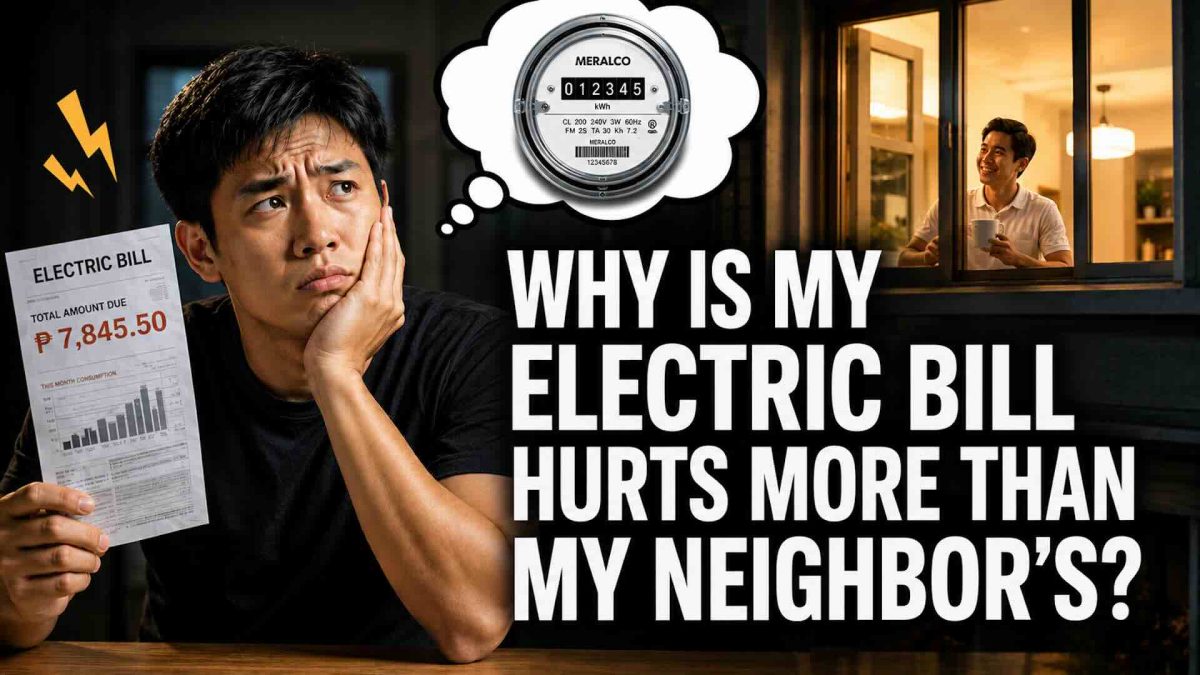
Open your Meralco app, check the rate, and wince. That’s the routine for most Metro Manila households by now. As of June 2026, Meralco charges ₱14.4833 per kilowatt-hour for a typical residential customer. Put a Malaysian household next to you with the same appliances, the same aircon habits, the same everything, and they’d pay a third of that.
This isn’t a new complaint. Filipinos have compared notes with relatives working in Bangkok or Kuala Lumpur for years and come away annoyed. What’s changed in 2026 is the size of the gap, driven by a peso that keeps sliding and a Middle East conflict that spiked fuel costs across the region starting in February. We pulled the current official rates from each country’s power regulator to show where the Philippines stands against real 2026 numbers, not estimates from three years ago.
The Numbers, Country by Country
We converted every rate to Philippine pesos using the current BSP reference rate (~₱61.5/USD) so the comparison reflects what you’d actually pay, not a stale exchange rate from a random blog post.
Singapore: ₱16.50/kWh. Still the most expensive in the region. Singapore imports nearly all its natural gas, and the Energy Market Authority’s July–September 2026 tariff jumped 17% quarter-on-quarter, the steepest hike in recent memory, largely from the same Middle East conflict hitting Philippine generation costs.
Philippines: ₱14.48/kWh. Second-highest, and the only fully privatized, unsubsidized market in this list outside Singapore and Japan.
Japan: ₱13.47/kWh. Slightly cheaper than the Philippines despite Japan’s own heavy reliance on imported LNG. Japan’s ten regional utilities compete for market share, which pulls the average down.
Thailand: ₱7.41/kWh. Roughly half the Philippine rate. Thailand’s Oil Fuel Fund absorbs part of the fuel-cost shock instead of passing all of it straight to consumers, though that fund has run a growing deficit through 2026 trying to keep rates capped.
Indonesia: ₱5.31/kWh. State-owned PLN kept rates frozen through Q3 2026 even though the formula technically called for an increase, a decision the energy ministry made explicitly to protect household budgets.
Vietnam: ₱5.17/kWh. State utility EVN, similar story: a government-run stabilization fund cushions the fuel shock rather than passing it through immediately.
China: ₱4.80/kWh. Tiered residential pricing kept deliberately low, with industry absorbing a larger share of the true cost.
Malaysia: ₱3.34/kWh. The cheapest by a wide margin. State-owned TNB, backed by Malaysia’s own oil and gas production through Petronas, keeps the base tariff low and adds only a small fuel-cost surcharge on top.
ELECTRICITY PRICE
COMPARISON
METRO MANILA (MERALCO, JUN 2026)
MORE EXPENSIVE
CHEAPER
CHEAPER
CHEAPER
CHEAPER
CHEAPER
CHEAPER
CHEAPER
PRIVATE, IMPORT-RELIANT GRIDS COST MORE, WHILE STATE-OWNED UTILITIES WITH DOMESTIC FUEL KEEP RATES LOW.
Why the Gap Exists (and Why It’s Not That Simple)
Here’s where a lot of comparisons stop, and where they get it wrong.
Every country cheaper than the Philippines on this list, except Japan, runs on some form of subsidy or state-absorbed cost. Indonesia, Vietnam, Thailand, Malaysia, and China all have government mechanisms that eat part of the fuel-cost spike so households don’t feel the full hit. The Philippines has none of that. Under the 2001 Electric Power Industry Reform Act, generation costs pass straight through to your bill, dollar for dollar, peso for peso, the same month they happen.
A 2022 study by International Energy Consultants, an Australian firm that advises power companies across Asia-Pacific, actually found Meralco’s rates were 3% below the 46-country average it surveyed, and 13% below average once the six most heavily subsidized countries were excluded. Then-Energy Secretary Raphael Lotilla made the same point directly: matching Indonesia, Malaysia, or Vietnam’s subsidy levels would cost the Philippine government an estimated ₱241 billion a year in taxpayer money we don’t currently spend on electricity.
So which framing is correct? Both, depending on the question you’re asking. If the question is “what do I actually pay at the end of the month,” the Philippines is expensive, full stop, and this comparison table proves it. If the question is “is Meralco secretly gouging Filipinos while efficient utilities elsewhere charge fairly,” the answer is more complicated: a meaningful chunk of that gap is the price of not subsidizing, not necessarily inefficiency.
That distinction matters for policy conversations, but it changes nothing about your bill this month. Whatever the cause, Filipino households are paying some of the highest unsubsidized electricity rates in Asia, generation costs make up more than half of every peso billed, and both figures move whenever the peso weakens or Middle East tensions flare, which they have repeatedly through 2026.
Related: Meralco Rate per kWh: How Much Is Electricity in the Philippines in 2026?
What Actually Moves Your Bill
Three things drive most of the month-to-month swing, based on Meralco’s own advisories this year:
- The peso-dollar rate. More than half of Meralco’s power supply agreements are dollar-denominated. When the peso weakens, as it did sharply in March 2026, generation charges rise the same month, no lag.
- Global fuel prices. Coal and LNG make up the bulk of Philippine generation. When Brent crude spikes, as it did after the February 2026 Strait of Hormuz disruption, that cost lands on your bill within one to two billing cycles.
- Grid stress in summer. Luzon’s grid hit Red Alert for three straight days in May 2026 as demand outpaced supply during the heat. Tight supply pushes Wholesale Electricity Spot Market prices up, and WESM charges get passed straight to consumers.
None of these are things a single household can control. What you can control is consumption timing and appliance efficiency, which is worth its own separate guide (link to your Meralco rate breakdown post here).
The Bottom Line
Philippine electricity costs more than almost anywhere else in Southeast Asia, and the honest reason is a mix of geography, import dependence, and a policy choice to not subsidize household rates the way five of your regional neighbors do. Neither fact cancels the other out. Both belong in the same conversation next time someone tells you your bill “shouldn’t” be this high, or that Meralco is solely to blame.
Sources: Meralco official rate advisories (June 2026), Energy Market Authority/SP Group Singapore, Thailand Energy Regulatory Commission, Indonesia PLN/Ministry of Energy and Mineral Resources, Vietnam Electricity (EVN), GlobalPetrolPrices.com, Tenaga Nasional Berhad Malaysia, International Energy Consultants 2022 study, Philippine News Agency, Inquirer.net.